A roofing estimate is a formal, itemized document that details every cost, material, and task involved in a roofing project before a single shingle is touched. Most homeowners treat it as a price sheet, but that misreads its real function. A thorough estimate, also called a roofing proposal or scope of work document, spans 4 to 8 pages with at least 10 distinct sections covering everything from contractor credentials to cleanup plans. Understanding what does a roofing estimate include protects you from hidden fees, contractor disputes, and costly surprises mid-project.
What does a roofing estimate include as essential components?
A complete roofing estimate breakdown covers nine core categories. Each one serves a specific purpose, and a missing category is a signal worth questioning before you sign anything.
- Contractor credentials. The estimate must list the company's name, physical address, license number, and proof of general liability and workers' compensation insurance. Without these, you have no legal recourse if work is substandard or a worker is injured on your property.
- Itemized scope of work. This section describes every task in sequence: tear-off of existing shingles, installation of ice and water shield, synthetic underlayment, drip edge, step flashing, pipe boots, ridge cap, and ventilation components. Vague language here is a red flag.
- Material specifications. A credible estimate names the exact product. "Architectural shingles" is not enough. The estimate should read "GAF Timberline HDZ in Charcoal, 30 squares" or "Owens Corning Duration in Estate Gray, 28 squares." Brand, product line, color, and quantity must all appear.
- Labor costs. Labor represents 50 to 70% of total project cost. That figure tells you labor is the single largest line item on most roofs, yet many estimates fold it into material line items rather than listing it separately. What matters is that the itemization is clear enough to prevent hidden charges for skipped tasks.
- Decking allowance. No contractor can see the condition of your roof deck until tear-off begins. A trustworthy estimate pre-prices a decking allowance of roughly $2 to $4 per board foot, covering the 5 to 15% of deck area that typically needs replacement. Without this line item, you face unpredictable change orders.
- Permit fees. Permit fees range from $100 to $500 depending on your locality. The estimate should state who pulls the permit and who pays for it. A contractor who skips permits puts your homeowner's insurance and future home sale at risk.
- Cleanup and debris disposal. Tear-off disposal averages $100 to $175 per square. The estimate should confirm that a dumpster or haul-away service is included and that the crew will use magnetic rollers to collect nails from your yard and landscaping.
- Warranty details. Two warranties apply to every roofing job: a manufacturer warranty covering materials (GAF and Owens Corning both offer enhanced warranties through certified contractors) and a workmanship warranty covering installation quality. Both should be listed with their duration and coverage terms.
- Payment schedule and project timeline. A legitimate contractor caps deposits at 10 to 30% of the total project cost. The estimate should also state the expected start date, project duration, and when final payment is due.
Pro Tip: Print the estimate and physically check off each of these nine categories before you agree to anything. If a category is missing, ask the contractor to add it in writing before signing.
What red flags should homeowners watch for in roofing estimates?
A roofing estimate functions as a contract preview that defines legal responsibilities and warranty commitments. That means a weak estimate is not just an inconvenience. It is a legal liability.
Watch for these warning signs:
- No license or insurance documentation. Any contractor who cannot provide a current license number and certificate of insurance is operating outside legal requirements in most states.
- Vague material descriptions. "30-year architectural shingles" without a brand name or product line gives the contractor room to substitute cheaper materials after you sign.
- No decking allowance. Omitting this line item is one of the most common ways contractors keep their bid artificially low, then hit you with a change order once the deck is exposed.
- Deposit over 30%. Requiring 50% or more upfront is a classic indicator of a contractor who may not return to finish the job.
- No physical roof inspection before quoting. A contractor who quotes from the ground or from Google Maps satellite images cannot accurately assess flashing condition, ventilation needs, or deck damage. Chattanoogaroofrepairs conducts a thorough roof inspection before producing any estimate.
- Missing permit line items. Omitting permits from the estimate often means the contractor plans to skip them entirely, which creates compliance problems and can void your manufacturer warranty.
- Pressure tactics. "Today-only pricing" or "we have a crew available right now" are sales tactics designed to prevent you from comparing bids. Reputable contractors give you time to review.
- Single-line total with no breakdown. A single-page total is a red flag that signals the contractor either cannot or will not account for individual cost components.
Pro Tip: Use a contractor questions checklist before your first meeting. Walking in prepared changes the dynamic and filters out contractors who are not used to being held accountable.
How do roofing estimates vary and how can you compare multiple bids?
Most homeowners assume a $4,000 price gap between two bids means one contractor is using cheaper shingles. That assumption is usually wrong. Scope differences explain bid disparity more than material type. One contractor may include synthetic underlayment, proper ventilation, and ice and water shield on all eaves. Another may quote felt paper, no ventilation upgrade, and ice shield only at valleys. Same shingles. Very different roofs.
Wide price differences often reflect overhead costs like insurance, training, and property protection rather than material markups. Low bids frequently lack legally required permits or use unskilled labor, creating compliance issues and premature roof failure.
The table below shows how to compare two bids side by side on the components that matter most.
| Component | Bid A (lower total) | Bid B (higher total) |
|---|---|---|
| Underlayment | 15 lb felt | Synthetic (stronger, longer-lasting) |
| Ice and water shield | Valleys only | All eaves and valleys |
| Decking allowance | Not included | $3/board foot, up to 10% of deck |
| Ventilation | No upgrade noted | Ridge vent replacement included |
| Permit | Not listed | Included, contractor pulls |
| Workmanship warranty | 1 year | 5 years |
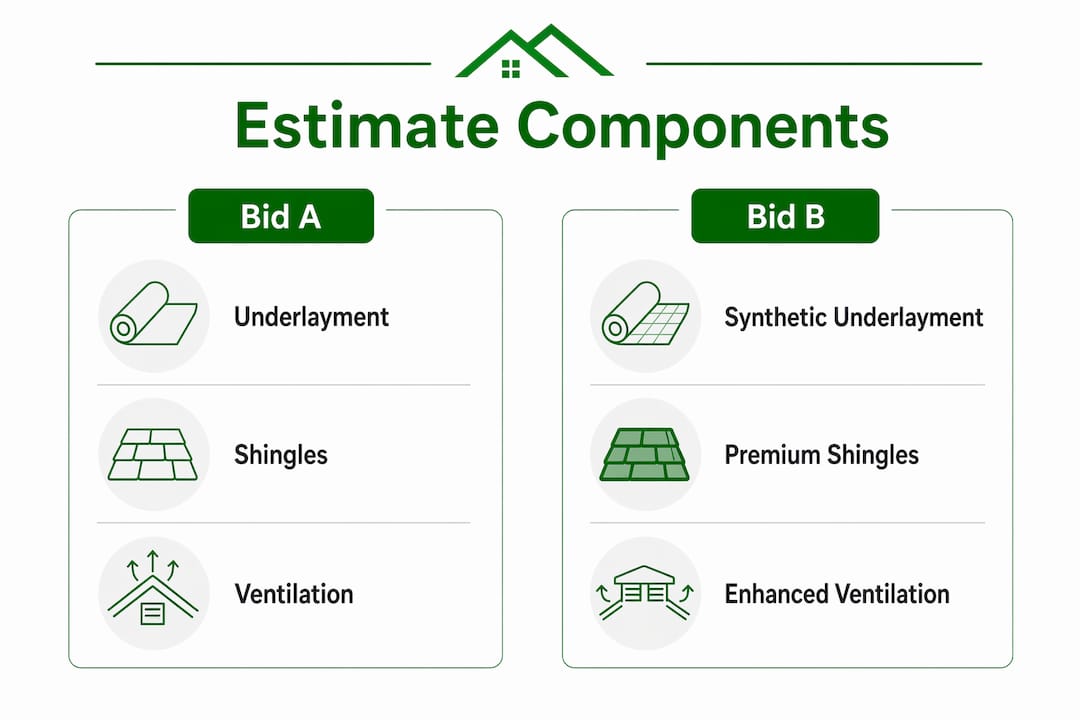
Bid B costs more because it includes more. That is not a flaw. Comparing bids line by line reveals that cheaper bids often omit critical components that become costly change orders later. A higher bid that includes decking allowance, proper ventilation, and a five-year workmanship warranty is almost always better value than a lower bid that skips all three.
How should you read and use your roofing estimate to prepare?
Reading a roofing estimate carefully before signing takes about 20 minutes and can save you thousands. Here is how to work through it systematically.
- Verify credentials first. Confirm the license number is active with your state licensing board and call the insurance carrier to verify coverage. Do not take the contractor's word for it.
- Read the scope of work line by line. Every task should be spelled out. If "flashing" appears without specifying step flashing, counter flashing, and pipe boots, ask for clarification.
- Confirm material specs. The estimate should name GAF, Owens Corning, or another recognized manufacturer by product line, color, and quantity. If it does not, request a written amendment before signing.
- Understand both warranties. Know what the manufacturer warranty covers (materials only) versus what the workmanship warranty covers (installation errors). Ask how long each lasts and what voids them.
- Check the decking allowance. If it is missing, ask the contractor to add a per-board-foot price and a cap percentage. This protects both of you.
- Review the payment schedule. A standard schedule is 10 to 30% at signing, a progress payment at material delivery, and the balance at completion. Avoid any schedule that requires more than 30% before work begins.
- Ask about change order policies. Any work beyond the original scope should require a written change order with a price before the work starts. Verbal agreements during a job are how disputes begin.
- Note the estimate validity period. Most estimates are valid for 30 to 60 days. Use that window to compare bids and check references rather than letting urgency push you into a fast decision.
Pro Tip: If you suspect storm damage is driving your repair need, get the inspection done before requesting estimates. An accurate damage assessment produces a more accurate scope of work and prevents underquoting.
Key takeaways
A roofing estimate is only as useful as the detail it contains. Homeowners who read it line by line, verify credentials, and compare scopes rather than totals make significantly better decisions and avoid costly surprises.
| Point | Details |
|---|---|
| Estimates span 4 to 8 pages | A single-page total is a red flag; expect at least 10 distinct sections. |
| Labor is the largest cost | Labor represents 50 to 70% of total project cost and must be clearly accounted for. |
| Decking allowance prevents surprises | Pre-priced at $2 to $4 per board foot, this line item protects against unexpected change orders. |
| Scope drives price differences | Bid gaps reflect underlayment, ventilation, and protection differences more than material brand. |
| Deposits over 30% are a warning sign | A legitimate contractor caps upfront payment at 10 to 30% of the total project cost. |
Why the estimate is the most important document you will sign
I have reviewed hundreds of roofing projects over the years, and the pattern is consistent. Homeowners who run into trouble almost never had a bad contractor from the start. They had a vague estimate that left too much room for interpretation, and both sides filled in the gaps differently.
The most common misunderstanding I see is treating the estimate as a formality. Homeowners skim the total, check that it fits the budget, and sign. Then the decking comes off and there is rot on 20% of the boards, and suddenly there is a $1,200 change order nobody planned for. That is not a contractor trick. That is a missing line item that both parties failed to address upfront.
A detailed scope of work is not just protection for you. It protects the contractor too. When every task is written down, there is no argument about whether pipe boots were included or whether the old ridge vent was supposed to be replaced. The document does the work.
My honest advice: treat the estimate review the same way you would treat reviewing a lease. Read every line. Ask about anything you do not recognize. A contractor who gets defensive when you ask questions is telling you something important about how the job will go. A contractor who welcomes the questions and answers them clearly is the one worth hiring.
— Steve
Get a transparent, detailed estimate from Chattanoogaroofrepairs
Chattanoogaroofrepairs provides fully itemized estimates covering every component discussed in this guide, from material specifications using GAF and Owens Corning products to decking allowances, permit responsibilities, and workmanship warranties. Every estimate follows an inspection, not a satellite image review.
If you are preparing for a repair or full replacement, the roofing services page outlines every option available, including roof leak repair, shingle replacement, and storm damage response. Chattanoogaroofrepairs serves Chattanooga and surrounding areas with licensed, insured crews and no-pressure consultations. Request your estimate today and know exactly what you are getting before any work begins.
FAQ
What should a roofing estimate always include?
A roofing estimate should always include contractor license and insurance information, an itemized scope of work, named material specifications, a decking allowance, permit details, cleanup plans, warranty terms, and a payment schedule. A document missing any of these categories is incomplete.
How many pages should a roofing estimate be?
A legitimate roofing estimate spans 4 to 8 pages with at least 10 distinct sections. A single-page document showing only a total price is a red flag indicating the contractor has not fully scoped the project.
Why do roofing estimates vary so much in price?
Price differences between roofing bids reflect scope and overhead more than material brand. Lower bids often omit ventilation upgrades, decking allowances, permits, or use thinner underlayment, all of which become additional costs later.
Is a large upfront deposit normal for roofing projects?
A deposit of 10 to 30% of the total project cost is standard. Any contractor requiring 50% or more upfront before work begins is operating outside normal industry practice and presents a financial risk.
What is a decking allowance and why does it matter?
A decking allowance is a pre-priced line item covering the cost of replacing damaged roof deck boards discovered after tear-off. Without it, any deck damage becomes an unplanned change order that can add hundreds or thousands of dollars to your final bill.