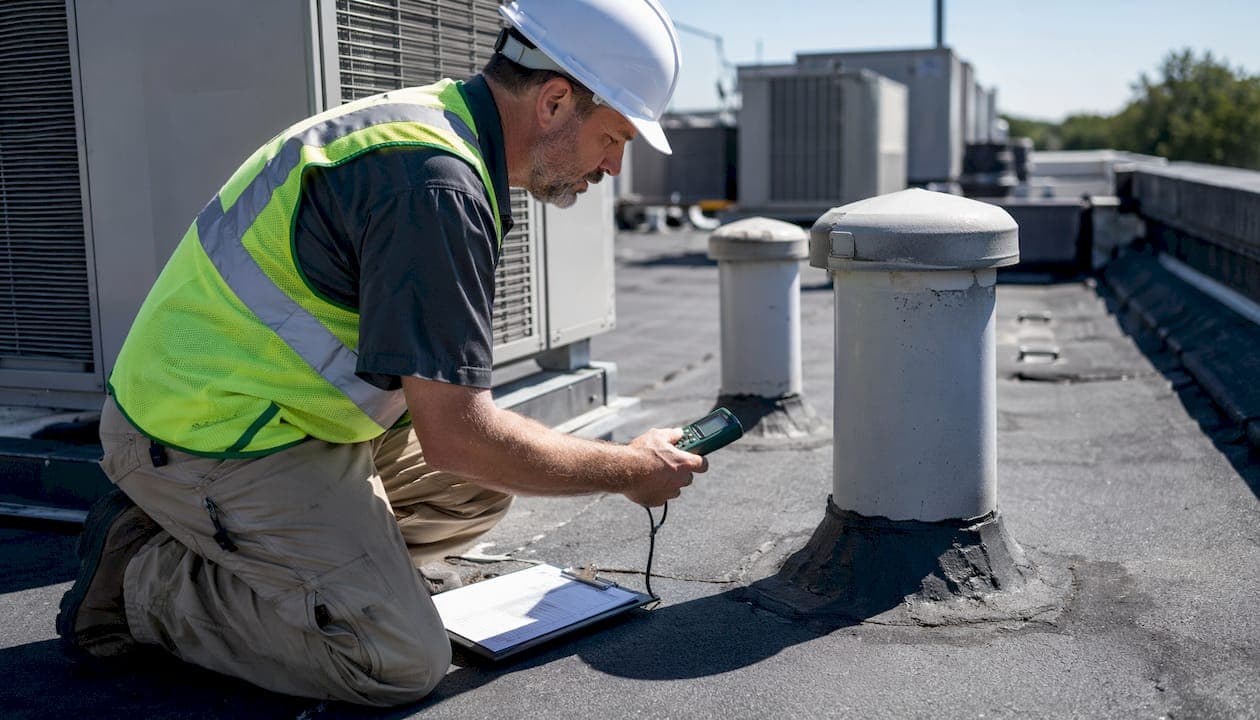
Rooftop equipment penetrations are the leading source of roof leaks because they break the continuous waterproof membrane and force sealants, flashings, and materials to handle constant movement and weather stress. The National Roofing Contractors Association (NRCA) identifies flashing failure as the cause of approximately 90% of leaks around chimneys, skylights, and vent penetrations. That figure alone reframes the entire conversation about why rooftop equipment penetrations cause leaks. The problem is rarely the membrane itself. It is almost always the detail work where equipment meets the roof surface.
Why do rooftop equipment penetrations cause leaks?
Every penetration, whether a plumbing vent, HVAC curb, exhaust fan, or electrical conduit, creates a gap in the roof membrane. That gap must be sealed and flashed to stay watertight. The challenge is that roofs are not static. They expand and contract with temperature changes, flex under load, and absorb vibration from rooftop equipment. Flashings and sealants must accommodate all of that movement, year after year, without cracking or pulling away.
Flashing is the metal or membrane material that wraps around a penetration and ties it back into the main roof surface. When flashing is installed incorrectly, uses the wrong material, or simply ages past its service life, water finds the gap. Pipe boots, the rubber or metal collars that seal plumbing vents, typically last 10–15 years before UV exposure and temperature cycling cause cracking. A cracked pipe boot on a 12-year-old roof is one of the most common and most overlooked causes of roof leaks.

Sealant degradation compounds the problem. Most sealants used around penetrations are silicone or urethane based. UV radiation breaks down their elasticity over time, causing them to shrink, crack, and lose adhesion. Once a sealant fails, water enters the gap and travels inside the roof assembly, often appearing as a stain on a ceiling far from the actual breach.
HVAC vibration and service traffic accelerate flashing wear significantly. Every time a technician walks across a flat roof to service equipment, they stress the flashing at each penetration they step near. Rooftop units that run continuously create low-frequency vibration that loosens mechanical connections and fatigues sealant bonds over months and years.
Pro Tip: Never rely on sealant alone to waterproof a penetration. Mechanical flashing, properly lapped and fastened, is the professional standard. Sealant is a secondary line of defense, not a primary one.
Industry data shows that roof curbs and penetrations account for 15%–25% of mechanical scope costs in reroof projects because of field modifications and flashing customizations. That cost reflects how often penetration details are underspecified at the design stage and corrected in the field at a premium.
Why are transition zones more vulnerable than the main membrane?
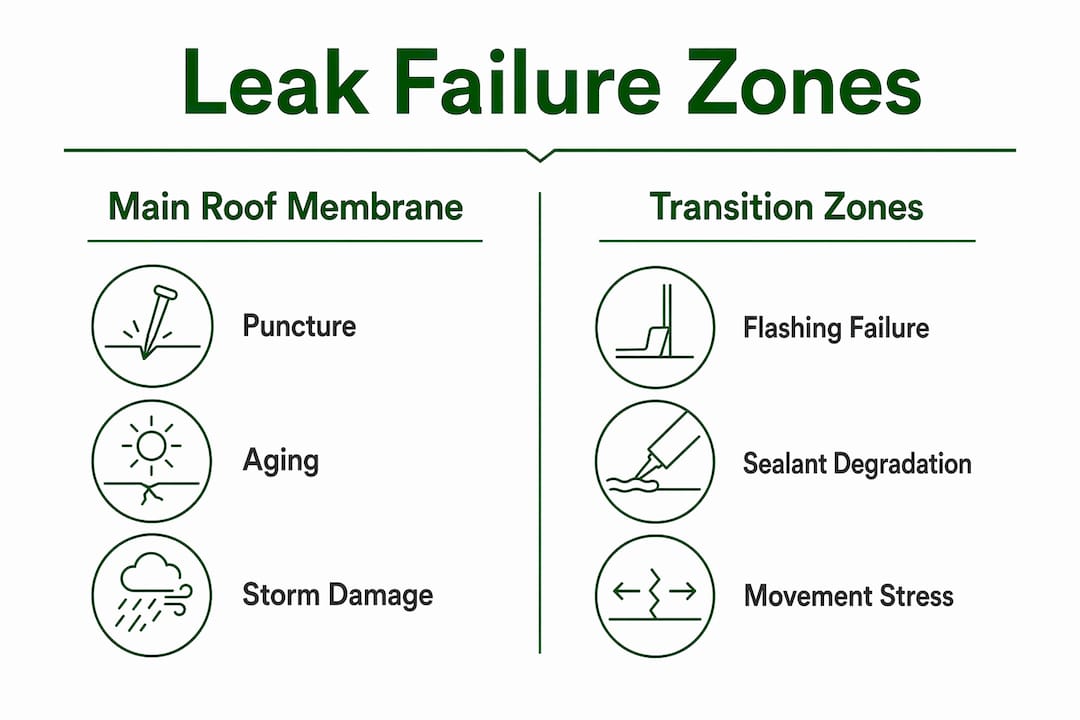
The main roof membrane on a flat or low-slope commercial roof is actually quite durable. Modern TPO, EPDM, and modified bitumen membranes resist puncture and UV degradation well. The weak points are the transition zones where the membrane meets something rigid: a pipe, a curb, a parapet wall, or a piece of equipment.
Transition zones fail because of differential movement. The roof deck flexes. The building structure does not flex at the same rate. A rigid HVAC curb bolted to the structural frame moves differently than the flexible membrane surrounding it. That difference in movement stresses the flashing and sealant at the joint, every single day, through every temperature swing.
Leaks rarely appear directly underneath the penetration point. Water enters at the flashing, travels along the decking and structural beams, and drips through the ceiling at a completely different location. This is why patching a visible drip point without tracing the actual source wastes time and money. The real breach could be 10 or 20 feet away from where the water shows up inside.
Improper patching makes this worse. When a contractor applies mastic or caulk over a failing flashing without removing the old material, they trap moisture underneath the patch. That trapped moisture accelerates membrane deterioration beneath the sealant layer. Mastic-only repairs are a temporary measure at best and a liability at worst.
Pro Tip: When you see a water stain on your ceiling, mark the location and then have a professional trace the leak path upward and outward. The entry point is almost never directly above the stain.
The table below compares the two primary failure zones to clarify where attention and budget should be focused.
| Failure zone | Primary cause | Typical repair |
|---|---|---|
| Main roof membrane | Puncture, aging, storm damage | Patch or full replacement |
| Transition zone at penetration | Flashing failure, sealant fatigue, differential movement | Mechanical flashing replacement |
How does modern leak detection technology find penetration failures early?
Electronic Leak Detection (ELD) is the most reliable method for finding breaches in roof membranes and flashings before they cause visible interior damage. ELD works by passing a low-voltage or high-voltage electrical current across the roof surface. Water conducts electricity. Where the membrane or flashing has failed, the current flows through the breach and triggers an alert. This method locates failures that are invisible to the naked eye.
ELD and continuous moisture sensors are underutilized in routine roof maintenance despite their proven effectiveness. Most property managers only call for leak investigation after interior damage appears. By that point, moisture has already been traveling through the roof assembly for weeks or months, degrading insulation and potentially supporting mold growth.
Continuous moisture sensors embedded in the roof assembly take a different approach. They monitor moisture levels in real time and send alerts when readings spike above baseline. This is especially useful on large commercial roofs with multiple penetrations where visual inspection alone cannot cover every detail point. For a deeper look at how these technologies work in practice, leak detection methods are explained in detail by water damage restoration specialists.
The practical benefits of ELD and moisture monitoring include:
- Early breach identification before water reaches interior spaces
- Precise location mapping that eliminates guesswork and reduces repair scope
- Documentation of roof condition for insurance claims and warranty compliance
- Quality control during new penetration installation to confirm proper sealing before the job is signed off
Requiring ELD testing after any new penetration is added is one of the highest-value quality control steps a property manager can take. It confirms the flashing and sealant work is sound before the crew leaves the site.
What steps prevent leaks at rooftop equipment penetrations?
Preventing equipment penetration issues starts with treating every penetration as a system, not a hole. Penetrations treated as simple holes to plug, rather than engineered components, consistently fail because they ignore thermal expansion and vibration stresses. The following steps give homeowners, property managers, and contractors a clear maintenance framework.
-
Schedule twice-annual professional inspections. Spring and fall inspections catch sealant cracking, flashing separation, and pipe boot deterioration before they become active leaks. A licensed roofing contractor should examine every penetration point, not just the membrane surface.
-
Require roofing contractor oversight for any new penetration. Poor trade coordination between roofing, HVAC, and electrical teams is a leading cause of compromised flashing sealing. When an HVAC technician cuts a new hole without a roofing professional present, the flashing detail is often inadequate from day one.
-
Watch for these warning signs between inspections. Bubbling or blistering sealant around a vent or curb, rust staining on metal flashings, daylight visible around a pipe boot, and soft or spongy decking near equipment are all signs of active moisture intrusion.
-
Replace failing flashings mechanically. Do not accept a mastic-only patch as a permanent repair. Proper flashing replacement means removing old material, preparing the substrate, and installing new metal or membrane flashing with mechanical fasteners and a compatible sealant as a secondary seal.
-
Address repairs promptly. Water that enters through a penetration does not stay contained. It migrates through insulation, reaches the structural deck, and can cause rot, mold, and structural damage within a single wet season. Scheduling prompt roof repairs prevents a $500 flashing fix from becoming a $15,000 structural repair.
Pro Tip: Ask your roofing contractor to photograph every penetration detail before and after any repair. That documentation protects you during warranty claims and gives the next inspector a baseline to compare against.
The consequences of commercial roof leaks extend well beyond the repair bill. Mold remediation, tenant disputes, and business interruption costs can dwarf the original roofing expense when leaks go unaddressed.
Key Takeaways
Rooftop equipment penetrations cause leaks primarily through flashing failure and sealant degradation at transition zones, not through membrane breakdown, making targeted maintenance at every penetration point the most effective prevention strategy.
| Point | Details |
|---|---|
| Flashing failure drives most leaks | Approximately 90% of leaks at penetrations trace back to flashing issues, not membrane defects. |
| Sealants have a finite lifespan | Pipe boots and sealants last 10–15 years; schedule inspections before that window closes. |
| Transition zones are the weak link | Differential movement between rigid equipment and flexible membranes stresses seals daily. |
| ELD finds breaches before damage shows | Electronic Leak Detection locates failures invisible to the eye, enabling repairs before interior damage occurs. |
| Trade coordination prevents new failures | Roofing contractors must oversee all new penetrations to maintain membrane integrity from day one. |
What I've learned from watching penetrations fail the same way, over and over
After years of inspecting roofs across Chattanooga and the surrounding region, the pattern is almost always the same. The membrane is fine. The penetration detail is not. Property managers spend thousands on full roof evaluations when the actual problem is a $200 pipe boot that cracked two winters ago.
The deeper issue is that penetrations get added over a building's life without any roofing professional in the room. An HVAC crew cuts a curb opening. An electrician runs conduit through the deck. Each trade does their part, and nobody owns the flashing detail. That gap in accountability is where water enters.
I also see property managers skip ELD testing because it feels like an extra cost. It is not. It is the only way to confirm that a new penetration is actually sealed before the crew leaves. Catching a failed seal on day one costs almost nothing. Catching it after two years of hidden moisture damage costs a great deal more.
The most durable roofs I have seen treat every penetration as a permanent part of the roof system, engineered and maintained with the same care as the membrane itself. That mindset shift, from "plug the hole" to "design the detail," is what separates roofs that last 30 years from roofs that leak in year seven.
— Steve
Chattanoogaroofrepairs specializes in penetration leak diagnosis and repair
Rooftop equipment penetrations require more than a tube of caulk and a ladder. They require a trained eye, the right materials, and a contractor who understands how flashings, membranes, and equipment interact as a system.

Chattanoogaroofrepairs provides comprehensive roof leak repair services in Chattanooga and surrounding areas, with a focus on diagnosing and fixing the penetration and flashing failures that cause most leaks. Every inspection includes a full review of penetration details, sealant condition, and flashing integrity. The team uses GAF and Owens Corning materials, carries full insurance, and provides transparent pricing with no pressure. If you are seeing water stains, soft spots near equipment, or aging sealant around vents, schedule a professional evaluation before the next rain season arrives.
FAQ
What is the most common cause of leaks at roof penetrations?
Flashing failure is the most common cause, responsible for approximately 90% of leaks around vents, chimneys, and skylights. Sealant degradation and improper installation are the next most frequent contributors.
How long do pipe boot seals last before they need replacement?
Plumbing vent pipe boots typically last 10–15 years before UV exposure and temperature cycling cause cracking and leaks. Twice-annual inspections catch deterioration before active leaks develop.
Why does my ceiling leak away from where the roof penetration is?
Water enters at the flashing breach and travels along decking and structural beams before dripping through the ceiling. The visible drip point is rarely directly below the actual entry point, which is why professional leak tracing is necessary.
What is Electronic Leak Detection and why does it matter for penetrations?
Electronic Leak Detection (ELD) uses electrical current to locate breaches in roof membranes and flashings that are invisible to the eye. It is the most reliable method for confirming penetration seals are sound after installation or repair.
Do I need a roofing contractor when HVAC work is done on my roof?
Yes. Poor coordination between roofing and HVAC trades is a leading cause of compromised flashing seals. A roofing contractor should oversee any new penetration to confirm the flashing detail maintains membrane integrity.