
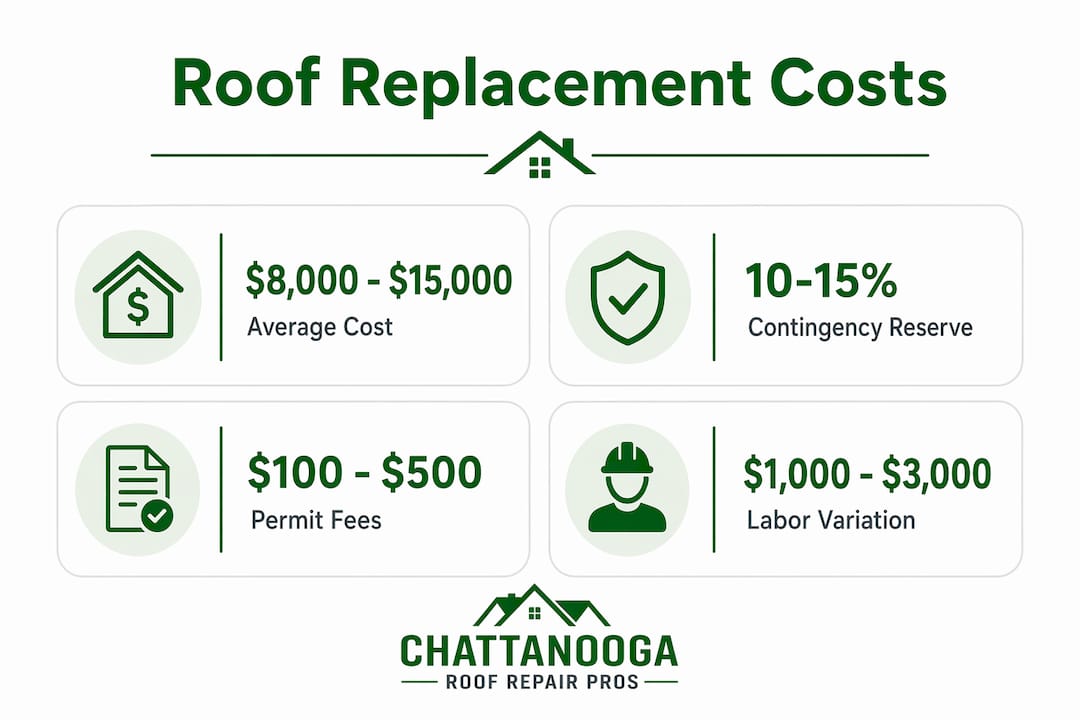
A roof replacement is one of the largest home improvement investments you will make, and a solid budget plan is the difference between a smooth project and a financial shock. The national average cost for replacing a roof on a standard 2,000-square-foot home runs between $8,000 and $15,000, with complex or high-end projects reaching $25,000 to $50,000 or more. This budget roof replacement planning guide walks you through every cost factor, financing option, and scheduling strategy you need to protect your home and your wallet. Chattanoogaroofrepairs recommends starting with a clear cost picture before you request a single bid.
What are the main costs in a budget roof replacement plan?
Material choice drives the largest share of your total cost. Asphalt shingles remain the most affordable option for most homeowners, while metal, tile, and slate carry higher price tags but longer lifespans. Your roof's size, measured in squares (one square equals 100 square feet), multiplies every per-unit material cost directly.
Labor costs rise with roof complexity. A steep pitch or multiple layers can add $1,000 to $3,000 to your labor bill alone. That figure matters because many homeowners price only materials when they first estimate a project, then get surprised when the final bid arrives.
Permits and disposal are two costs that often get overlooked. Permit fees typically add $100 to $500 to your budget, depending on your municipality. Debris hauling and dumpster fees can add several hundred dollars more, especially if your old roof has multiple layers to remove.
The single most important budget rule is the contingency reserve. A 10–15% contingency buffer covers hidden problems like rotted decking, damaged rafters, or ventilation deficiencies that only appear after the old roof comes off. Skipping this buffer is the most common reason projects run over budget.
Here is a quick breakdown of typical cost ranges by material type:
| Material | Avg. Cost per Square | Lifespan |
|---|---|---|
| Asphalt shingles | $100–$200 | 20–30 years |
| Architectural shingles | $150–$300 | 25–40 years |
| Metal roofing | $300–$700 | 40–70 years |
| Tile or slate | $500–$1,500+ | 50–100 years |
Key cost factors to track in your budget:
- Roof size in squares
- Material type and grade
- Roof pitch and complexity
- Number of existing layers to remove
- Permit and inspection fees
- Debris disposal
- Contingency reserve (10–15% of total estimate)
Pro Tip: Get your roof measured professionally before you request bids. An accurate square footage figure prevents contractors from padding estimates or underquoting square counts.
How do you get and compare roofing estimates accurately?
Getting multiple bids is not optional. Prices across contractors can vary by 20–30% for the same scope of work, which means skipping this step could cost you thousands. Request at least 3 to 5 itemized bids so you have a real basis for comparison.
Itemized bids matter more than total price. A detailed bid lists materials by brand and grade, labor costs, permit fees, disposal, and warranty terms separately. When you compare line items instead of totals, you can see exactly where one contractor is cutting costs versus another.
Choosing the lowest bid without reviewing the details often results in skipped flashing, missing underlayment, or inadequate debris cleanup. These shortcuts create leaks and structural damage that cost far more to fix than the original savings. A low total price frequently signals that something important was left out of the scope.
Contractor reputation and warranty terms belong in your evaluation as much as price does. Verify that each contractor is licensed and insured. Ask about manufacturer-backed warranties on materials, which brands like GAF and Owens Corning offer through certified installers. A contractor who carries these certifications has met specific training and quality standards.
- Ask each contractor for a written, itemized bid
- Confirm license and insurance documentation
- Check online reviews and ask for local references
- Compare warranty terms on both materials and labor
- Ask what happens if hidden damage is found during tear-off
Pro Tip: Ask each bidder to walk you through their bid line by line. A contractor who cannot explain their own numbers is a contractor worth skipping. You can learn more about what a roofing estimate includes before your first meeting.
What financing options work best for roof replacement budgeting?
Cash payment is the most cost-effective way to pay for a roof replacement. Cash buyers often receive 3–5% discounts from contractors who prefer to avoid credit card processing fees and financing delays. On a $12,000 project, that discount saves $360 to $600 outright.
Home equity loans and home equity lines of credit carry interest rates in the 5–8% APR range and are often the best financing choice when cash is not available. The interest may be tax-deductible, and the rates are significantly lower than unsecured options. Financial advisors recommend keeping total housing debt below 28% of your gross monthly income when taking on any home improvement loan.
Personal loans are faster to obtain but carry rates from 7–25% APR depending on your credit score. Avoiding personal loans above 15% APR is sound advice unless the roof failure is urgent and no other option exists. If your roof is aging but not yet failing, saving for 6 to 12 months is a better path than locking in high-interest debt.
Contractor financing programs sometimes offer 0% APR for 12 to 18 months. These deals work well if you can pay off the balance before the promotional period ends. Missing that deadline typically triggers retroactive interest at a much higher rate, so read the terms carefully before signing.
| Financing Method | Typical APR | Best For |
|---|---|---|
| Cash payment | 0% (plus 3–5% discount) | Homeowners with savings ready |
| Home equity loan | 5–8% | Larger projects, tax benefit potential |
| Personal loan | 7–25% | Urgent needs, no home equity |
| Contractor financing | 0% promotional | Short-term payoff within promo window |
Pro Tip: If you are considering a home equity loan, get pre-approved before you start collecting bids. Knowing your borrowing limit helps you set a realistic budget ceiling from day one.
How can timing your roof replacement save money?
Scheduling your project during the off-season is one of the most reliable ways to reduce costs. Off-season installation, typically late fall through winter, can save 10–15% because contractors offer discounts to keep crews working during slower months. On a $12,000 project, that is $1,200 to $1,800 in savings without changing a single material.
One important condition applies to winter installations. Asphalt shingles require temperatures above 40°F to seal properly. Scheduling during a mild stretch in late fall or early winter, rather than the coldest weeks, protects both your savings and the quality of the finished roof.
A typical roof replacement project follows this timeline:
- Initial inspection and assessment (Days 1–3): A licensed contractor inspects the roof, identifies damage, and measures the area.
- Bid collection and contractor selection (Days 4–14): You gather 3 to 5 itemized bids, review them, and select your contractor.
- Permit application (Days 15–25): Your contractor submits permit paperwork. Permit approval typically takes 5–10 days and adds $100 to $500 to the budget.
- Material ordering and delivery (Days 26–35): Materials are ordered and staged at your property.
- Installation (Days 36–39): Most residential roofs take 2 to 4 days to install.
- Final inspection and cleanup (Days 40–42): The municipality inspects the completed work, and the contractor removes all debris.
Planning around this six-week window prevents the rushed decisions that lead to budget overruns. Homeowners who start the process in september or october are well-positioned to capture off-season pricing before winter weather closes the installation window.
What budgeting mistakes do homeowners most often make?
Underestimating hidden repair costs is the most expensive mistake in roof replacement planning. Rotted plywood, damaged rafters, and ventilation deficiencies are invisible until the old roof comes off. A contingency reserve of 10–15% of your total estimate protects you from these surprises without derailing the project.
Choosing low-cost materials to save money upfront often costs more over time. A lower-grade shingle may last 15 years instead of 30, meaning you pay for two roofs in the time a quality product would have covered you once. Upgrading to Class 4 impact-resistant materials can reduce insurance premiums by 5–35%, which offsets the higher upfront cost across the roof's lifespan.
Skipping permits or hiring unlicensed contractors creates serious legal and financial risk. Unpermitted work can void your homeowner's insurance, complicate a future home sale, and leave you liable for code violations. Always confirm that your contractor pulls the required permits and that the work passes a final municipal inspection.
Choosing the cheapest contractor without reviewing their credentials, insurance, and warranty terms is the fastest way to turn a $12,000 project into a $20,000 problem. The bid is not the budget. The bid plus hidden repairs, plus rework, plus legal exposure is the real number you need to plan for.
- Never skip the contingency reserve
- Do not choose materials based on price alone
- Always verify contractor licensing and insurance
- Require permits for all replacement work
- Read financing terms before signing anything
Key Takeaways
Effective roof replacement budgeting requires accurate cost estimates, a 10–15% contingency reserve, multiple itemized bids, and a financing plan matched to your financial situation.
| Point | Details |
|---|---|
| Know your full cost range | National averages run $8,000–$15,000 for standard homes, with complex projects reaching $50,000+. |
| Build a contingency reserve | Set aside 10–15% of your estimate to cover hidden damage found during tear-off. |
| Compare bids by line item | Collect 3–5 itemized bids and compare scope, not just totals, to avoid low-quality contractors. |
| Match financing to your situation | Cash saves 3–5%, home equity loans offer low rates, and high-APR personal loans should be a last resort. |
| Time your project for savings | Off-season scheduling can cut costs by 10–15% while contractor availability is higher. |
What I have learned after years of watching homeowners budget for roofs
The most consistent mistake I see is treating the contractor's initial quote as the final number. It never is. Hidden decking damage, ventilation upgrades, and code-required flashing changes appear on nearly every project I have worked on. The homeowners who handle these surprises without stress are the ones who built a real contingency into their budget before the first nail was pulled.
I also think the industry underserves homeowners on the timing conversation. Most people schedule a roof replacement when they notice a leak, which is almost always the worst time to get competitive pricing. The homeowners who plan ahead, get their roof inspected in late summer, and schedule work for october or november consistently pay less and get better contractor attention than those scrambling after a storm.
My honest advice: do not let price be your primary filter when choosing a contractor. A licensed, insured contractor using GAF or Owens Corning materials with a manufacturer-backed warranty is worth paying more for. The warranty alone can save you thousands if something goes wrong in year three. Budget for quality the first time, and you will not be budgeting for a second replacement in fifteen years.
— Steve
Chattanoogaroofrepairs: your local partner for budget-smart roof replacement
Chattanoogaroofrepairs serves Chattanooga and surrounding areas with certified expertise, transparent pricing, and no-pressure estimates that give you a clear picture before any work begins.
Whether you need a full roof replacement estimate or are weighing the long-term value of metal roofing against traditional shingles, our team provides itemized bids backed by GAF and Owens Corning materials and manufacturer-backed warranties. Homeowners dealing with storm damage can also access our storm damage repair services, including same-day tarping to prevent further loss while you plan your next steps. Contact Chattanoogaroofrepairs for a free, no-pressure consultation and get the accurate numbers you need to plan with confidence.
FAQ
What is the average cost of a roof replacement in 2026?
The national average runs between $8,000 and $15,000 for a standard 2,000-square-foot home. Complex projects with premium materials can reach $25,000 to $50,000 or more.
How much contingency should I budget for a roof replacement?
A 10–15% contingency reserve is the standard recommendation. Hidden damage like rotted decking or ventilation problems is common and only becomes visible after tear-off begins.
How many roofing bids should I get before choosing a contractor?
Get at least 3 to 5 itemized bids. Prices can vary by 20–30% across contractors, and comparing line items rather than totals reveals where quality differences actually exist.
Can I save money by scheduling my roof replacement in the off-season?
Off-season scheduling, typically late fall through winter in mild climates, can reduce costs by 10–15%. Asphalt shingles require temperatures above 40°F to seal correctly, so avoid the coldest weeks.
Is contractor financing a good option for roof replacement?
Contractor financing at 0% APR for 12 to 18 months works well if you can pay the full balance before the promotional period ends. Missing that deadline usually triggers retroactive interest at a much higher rate.