
A roofing contractor's Certificate of Insurance (COI) is proof that an insurer issued a policy on record — but it does not guarantee that policy covers your specific claim, your property, or even the workers on your roof right now. That distinction matters more in roofing than in almost any other home trade. Roofing is classified as a high-hazard occupation by the Bureau of Labor Statistics, with falls as the leading cause of serious injury and death in the industry. When something goes wrong on a residential roof job, the financial consequences flow fast, and they often flow toward the homeowner if the contractor's insurance paperwork has gaps.
Here is what you need to know before any roofer sets foot on your property:
- A COI is a summary document, not the full policy. It lists coverage types, limits, and dates, but does not itself create coverage.
- The core reason roofing contractors need insurance certificates is to document risk transfer. Without it, injuries, property damage, and subcontractor claims can become your financial problem.
- Verification goes beyond accepting the certificate. You must confirm endorsements, policy status, and additional insured language directly with the insurer.
- Chattanoogaroofrepairs works with fully insured, licensed crews and can walk you through what a proper COI looks like before any work begins.
Table of Contents
- What a COI actually is — and what it does not prove
- Core insurance coverages roofers should carry — and what to look for on a COI
- How to read a roofer's COI: the fields you must check
- Common gaps and pitfalls COIs hide — why a COI can give false security
- How to verify a roofer's COI before work begins
- US legal context: when insurance is required and what your liability looks like
- Why roofing insurance costs more — and why that matters when you hire
- Pre-hire checklist for homeowners and property managers
- A realistic claim scenario that exposes COI gaps
- Key Takeaways
- What verified insurance actually signals about a contractor
- Chattanoogaroofrepairs makes it easy to hire with confidence
- Useful sources for further reading
What a COI actually is — and what it does not prove
A Certificate of Insurance is a one-page summary document issued by an insurer or broker. It lists the contractor's name, the insurer's name, policy numbers, coverage types, coverage limits, and the policy's effective and expiration dates. Municipalities, general contractors, and property owners routinely require COIs before allowing work to begin on a site.
What a COI does not do is equally important to understand:
- It is not the insurance policy itself. The full policy document governs what is and is not covered.
- It does not create coverage. If a contractor's policy has exclusions or has lapsed, the COI does not override that.
- It does not prove endorsements exist. A COI may list "additional insured" language in a description box, but that language has no legal force unless a formal endorsement is attached to the actual policy.
- It does not confirm the policy is still active. A COI can be issued and then the policy canceled the next day.
Homeowners commonly make the mistake of accepting a COI at face value and assuming they are fully protected. Industry experts advise treating the COI as a starting point for verification, not a finish line. The certificate tells you a policy existed when it was issued. Your job is to confirm it still exists, covers the right things, and names you correctly.
Pro Tip: If a COI looks generic, has no endorsements block, or the insurer name is unfamiliar, ask the contractor to have their agent email you the endorsement pages directly. A legitimate insurer can do this in minutes.
Core insurance coverages roofers should carry — and what to look for on a COI
Not every policy type carries equal weight for your protection. Here is what a properly insured roofing contractor should have on file:
- General Liability (GL): Covers third-party bodily injury and property damage. Common minimum limits are $1 million per occurrence and $2 million aggregate. This is the baseline coverage most licensing boards and GCs require.
- Workers' Compensation: Covers medical costs, lost wages, and rehabilitation for employees injured on the job. Most states legally require it for contractors with employees. Without it, an injured worker's claim can land on your homeowner's policy.
- Commercial Auto: Covers vehicles used for business purposes. If a contractor's truck damages your driveway or a vehicle is involved in an accident while hauling materials to your home, personal auto insurance will not cover it.
- Umbrella/Excess Liability: Provides additional coverage above GL and auto limits. On larger projects or high-value homes, this matters.
- Completed Operations/Products Liability: Covers claims that arise after the job is finished, such as a roof leak discovered months later. This is a frequent blind spot — many contractors carry ongoing operations coverage but lack a completed operations endorsement (ISO form CG 20 37 is one indicator to look for).
- Professional Liability: Less common in residential roofing but relevant for design-build or consulting work. Covers claims of negligence or faulty advice.
State licensing boards and project contracts may require different minimums or specific endorsements. Some roofers carry only the minimum state-required coverage or elect exemptions for workers' comp if they are sole proprietors. Always ask for specifics, not just a COI.
How to read a roofer's COI: the fields you must check
A standard COI follows the ACORD 25 form layout. Knowing which fields to look at saves time and prevents costly oversights.
Named Insured: This must match the legal name of the contractor you hired. A mismatch is a red flag.
Insurer Name: Verify this is a real, licensed carrier. You can check insurer licensing through your state's Department of Insurance website.

Policy Numbers: Record these. You will need them if you call the insurer to verify coverage.
Policy Effective and Expiration Dates: Confirm the policy is active for the full duration of your project. A policy that expires mid-job leaves you exposed.
Coverage Types and Limits: Check that GL, workers' comp, and commercial auto are all listed with adequate limits. A $300,000 GL limit on a $150,000 roof replacement is thin.
Certificate Holder vs. Additional Insured: The certificate holder is simply the party the COI was issued to. Being a certificate holder gives you no rights under the policy. Additional insured status is different. It means you are named on the policy itself and can make a claim directly. Additional insured status requires a formal endorsement on the policy, not just a note on the COI.
Endorsements Block / Description of Operations: This box often contains language about additional insured or waiver of subrogation. That language is only enforceable if the corresponding endorsement is attached to the actual policy.
Pro Tip: Before work starts, photograph the COI and write down the insurer's phone number and each policy number. If a claim arises, you will need these details fast, and contractors are sometimes hard to reach mid-dispute.
Common gaps and pitfalls COIs hide — why a COI can give false security
A COI can look complete and still leave you exposed. These are the gaps that show up most often in roofing claims:
- Missing completed operations coverage. A contractor's GL policy may cover active work but exclude claims that arise after the job is done. Roof defects often surface weeks or months later.
- Lapsed or canceled policies. A policy can be canceled after the COI is issued. Unpaid premiums are a common cause. The COI date tells you nothing about the policy's current status.
- Subcontractor exposures. Many roofing GCs use subcontractors for labor. If a subcontractor lacks their own COI, the GC's policy may not cover them, and the liability gap can reach you.
- Restrictive exclusions. Some roofing policies exclude water damage from open-roof conditions, which is exactly the scenario that occurs during a re-roof when rain arrives unexpectedly.
- Additional insured endorsements listed but not issued. The description box on a COI may say "additional insured included," but unless the endorsement is on the policy, that language is unenforceable.
- Waiver of subrogation absent. Without this waiver, the contractor's insurer can sue you to recover money it paid out, even after a claim is settled.
Roofing's high-hazard classification drives higher claim frequency and severity than most residential trades. That elevated risk is exactly why these gaps matter more on a roofing job than on a painting or landscaping contract.
Red flags to watch for: a generic insurer name you cannot verify, no endorsements block on the COI, a named insured that does not match the contractor's business name, or a policy expiration date that falls before your project ends.
How to verify a roofer's COI before work begins
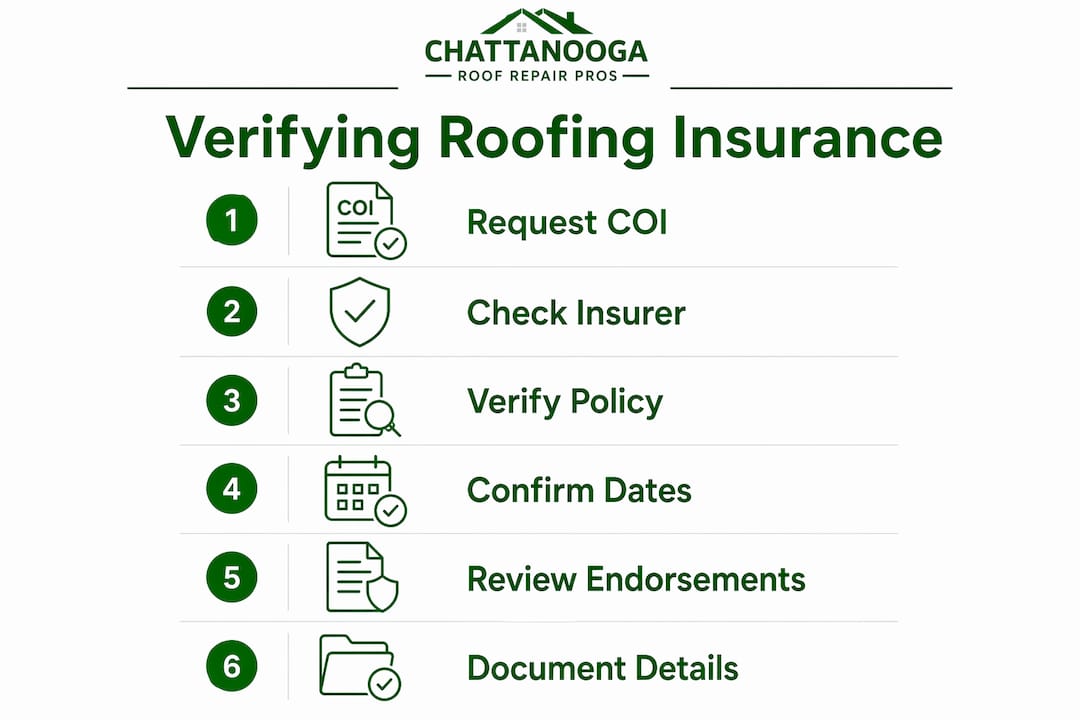
Verification takes about 15 minutes and can save you thousands. Follow these steps in order:
- Request the COI and endorsement pages before signing any contract. Ask for GL, workers' comp, commercial auto, and any umbrella policy. Request the actual endorsement pages, not just the summary certificate.
- Check the named insured, policy dates, and limits. Confirm the contractor's legal name matches, the policy covers your full project timeline, and limits meet your project's scope.
- Call the insurer or broker listed on the COI. Ask: "Is policy number [X] currently active? Does it include an additional insured endorsement for [your name/address]? Does it include completed operations coverage and a waiver of subrogation?" Insurers and agents can confirm policy status and endorsement language over the phone.
- Request an additional insured endorsement naming you specifically. This is a formal document, not a checkbox. It typically costs the contractor little or nothing to add.
- Verify workers' compensation separately. Ask for the workers' comp certificate and confirm it covers all employees and any subcontractors who will be on your property.
- Request updated COIs for extended or multi-phase projects. If your project spans a policy renewal date, get a new COI after the renewal.
- Document everything. Keep COI copies, endorsement pages, and your notes from the insurer call in a project documentation file. Note expiration dates on your calendar.
Sample verification script: "Hi, I'm calling to verify a certificate of insurance for a contractor I'm considering hiring. The policy number is [X], issued by your company. Can you confirm the policy is currently active, the coverage limits, and whether an additional insured endorsement has been issued for [your name]?"
Pro Tip: Ask the contractor for their agent's direct contact information, not just the insurer's general number. The agent can issue endorsements and answer coverage questions faster than a general claims line.
US legal context: when insurance is required and what your liability looks like
Insurance requirements for roofing contractors vary by state, but the legal exposure for homeowners is consistent across the country.
- Licensing and proof of insurance: Many states require licensed roofing contractors to carry minimum GL and workers' comp coverage and to show proof to the licensing board. State workers' compensation boards set coverage amounts based on payroll and NCCI class codes. Check your state's contractor licensing board for exact minimums.
- State variation on workers' comp: Some states allow sole proprietors or very small contractors to opt out of workers' comp. If your roofer has opted out and a worker is injured on your property, the injured worker may pursue a claim against you directly.
- Homeowner liability exposure: When a contractor lacks GL or workers' comp, claims often flow to the homeowner's policy. Your homeowner's insurance may cover the loss, but your premiums will likely rise and your insurer may pursue the contractor for reimbursement, pulling you into litigation.
- Property manager exposure: Property managers face the same risk, with the added complexity that a tenant or building occupant may also be affected, expanding the liability chain.
- COI is not a substitute for contract language. A signed contract should specify the contractor's insurance obligations, indemnity clauses, and what happens if coverage lapses. A COI alone does not create those obligations.
The Insurance Information Institute recommends verifying that both liability and workers' compensation certificates are active at the time your work is scheduled, not just at the time of signing.
Why roofing insurance costs more — and why that matters when you hire
Roofing carries some of the highest workers' compensation rates of any trade. Workers' comp rates for roofers can run many times higher than rates for office workers, driven by NCCI class codes that reflect the industry's fall and injury history. That cost shows up in a contractor's bid.
When you see a higher quote from a fully insured roofer, part of that difference is the cost of proper risk transfer. An uninsured or underinsured contractor can offer a lower price precisely because they are shifting risk onto you. Understanding how insurance costs appear in roofing estimates helps you compare bids honestly.
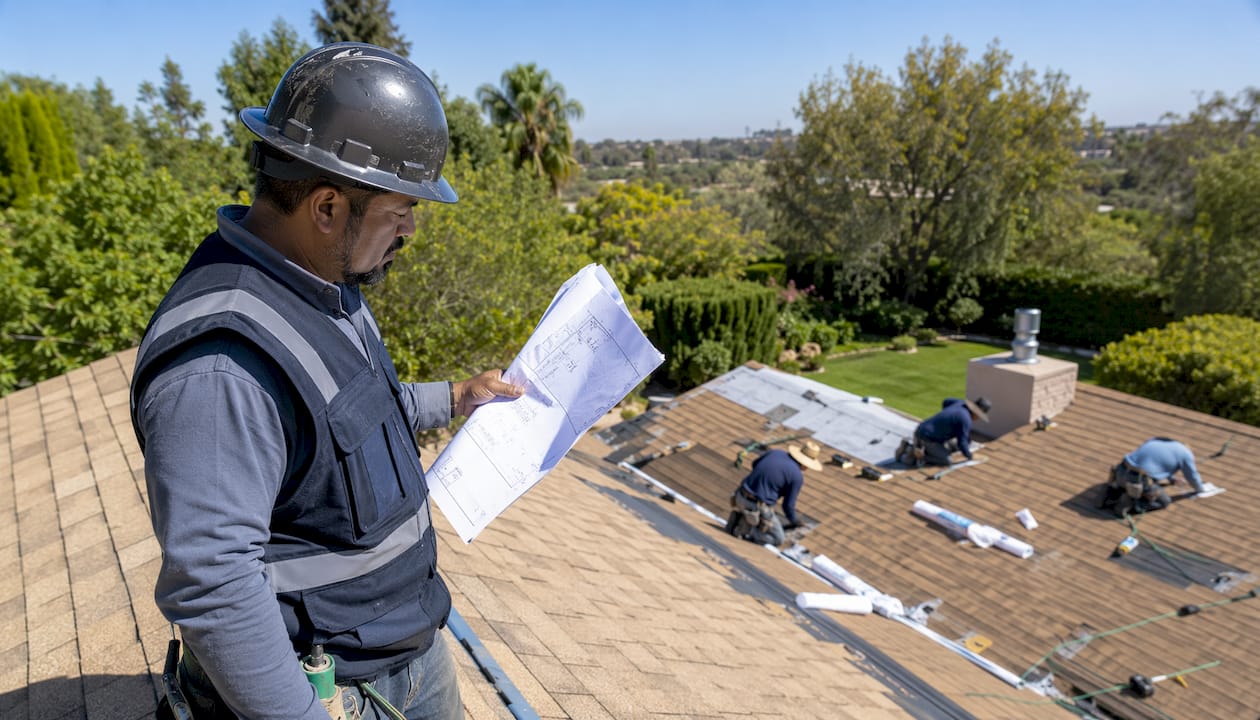
Strong certificate management also affects the contractor's own insurance costs at renewal. Poor COI practices can complicate claims and signal to underwriters that a contractor's risk controls are weak. A contractor who manages COIs carefully is generally a contractor who manages job-site risk carefully.
Pre-hire checklist for homeowners and property managers
Use this list during every contractor interview before signing anything:
- Current COI with policy numbers, named insured, and effective/expiration dates
- General liability certificate showing at least $1 million per occurrence / $2 million aggregate
- Workers' compensation certificate covering all employees and subcontractors on site
- Commercial auto certificate if contractor vehicles will be on your property
- Additional insured endorsement naming you (or your property management company) specifically
- Waiver of subrogation endorsement on the GL policy
- Completed operations coverage confirmed in writing or via endorsement
- Subcontractor COIs on file with the GC (ask the contractor to confirm this)
- Signed contract with indemnity clause and insurance obligation language
- Insurer or broker contact information for direct verification
- COI retention plan for multi-phase or extended projects
For the contract, request language along these lines: "Contractor shall maintain general liability insurance of not less than $1,000,000 per occurrence and $2,000,000 aggregate, naming [Owner Name] as additional insured, and shall provide a waiver of subrogation in favor of Owner."
A realistic claim scenario that exposes COI gaps
Here is how a COI failure plays out in practice.
A homeowner hires a roofing GC for a full replacement. The GC provides a COI showing GL coverage. The homeowner accepts it and signs the contract. The GC subcontracts the labor to a small crew. That crew's employer carries no workers' compensation. During the job, a subcontractor falls and suffers a serious injury.
The injured worker's attorney looks for coverage. The subcontractor's employer has none. The GC's GL policy excludes injuries to subcontractors not listed as additional insureds. The homeowner is not named as an additional insured on the GC's policy, so the homeowner cannot make a direct claim. The injured worker's attorney names the homeowner as a party, arguing the homeowner controlled the premises.
The practical consequences:
- The homeowner's insurance is drawn into the claim, potentially paying out and raising premiums.
- The homeowner faces legal costs even if ultimately not found liable.
- The project stalls while the dispute is resolved.
- The homeowner has no direct recourse against the GC's insurer because they were never added as an additional insured.
What would have prevented this: calling the insurer to confirm the additional insured endorsement was on the policy, requiring the GC to provide subcontractor COIs before work started, and including indemnity language in the signed contract. These are the steps in the verification workflow above. None of them are complicated. All of them take less time than a single phone call with an attorney.
Key Takeaways
A COI proves a policy was issued, but only direct insurer verification of endorsements and policy status protects you as a homeowner or property manager.
| Point | Details |
|---|---|
| COI is a starting point | A certificate proves a policy existed when issued; call the insurer to confirm it is still active and endorsed. |
| Additional insured requires an endorsement | Being named on a COI description box is not the same as holding a formal additional insured endorsement on the policy. |
| Workers' comp gaps shift risk to you | If a contractor's workers' comp lapses or excludes subcontractors, injured workers may pursue claims against your property. |
| Completed operations is a common blind spot | Confirm this coverage exists in writing; many GL policies cover active work but not defects discovered after the job ends. |
| Chattanoogaroofrepairs | Works with fully insured, licensed crews and provides transparent documentation before any project begins. |
What verified insurance actually signals about a contractor
Most homeowners focus on the certificate itself. The more useful signal is how a contractor responds when you ask for verification. A contractor who hands over their agent's direct number, offers to have endorsements emailed to you, and does not flinch at the request to confirm subcontractor COIs is telling you something important about how they run their business overall.
The contractors who push back on verification requests, claim the COI "should be enough," or cannot name their insurer off the top of their head are showing you their risk management culture. On a high-hazard job like roofing, that culture determines whether a near-miss becomes a claim or gets handled before anyone gets hurt.
There is also a practical financial point that does not get enough attention. A higher bid from a fully insured roofer is not just covering the cost of the policy. It reflects the cost of proper workers' comp rates, which for roofing trades are among the highest in the construction industry. When an uninsured contractor bids 20% lower, they are not more efficient. They are transferring their risk to you and to the workers on your roof. That is a bad deal at any price.
One more thing: the completed operations gap is the one that surprises homeowners most. A roof leak that shows up six months after the job is done is not covered by a policy that only protects ongoing operations. Ask about it specifically. If the contractor cannot tell you whether their policy includes it, that is your answer.
Chattanoogaroofrepairs makes it easy to hire with confidence
Hiring a roofer in Chattanooga should not feel like a research project. Chattanoogaroofrepairs brings fully insured, licensed crews to every job, with transparent documentation so you know exactly what coverage is in place before work starts. Every project includes a comprehensive 21-point inspection, and the team is ready for same-day tarping when storm damage cannot wait.
If you need a roof leak repair handled by a crew whose insurance you can actually verify, or if you want a no-pressure inspection before committing to any contractor, Chattanoogaroofrepairs is ready to help. Reach out through the services page to schedule your inspection or get a straightforward quote. No guesswork, no pressure, just clear answers from a local team that stands behind its work.
Useful sources for further reading
These U.S.-focused resources provide authoritative guidance on roofing insurance requirements, contractor licensing, and COI verification:
- Bureau of Labor Statistics: Occupational injury and fatality data that establishes roofing's high-hazard classification and informs insurance underwriting.
- Insurance Information Institute (Triple-I) Roof Toolkit: Practical guidance for homeowners on verifying contractor credentials, including COI and workers' comp verification steps.
- IRMI: Expert risk management guidance on COI limitations, endorsement requirements, and certificate management best practices.
- OSHA: Fall prevention and safety standards for roofing that explain the regulatory context behind high workers' comp rates.
- Your state's contractor licensing board: The definitive source for minimum insurance requirements, license verification, and workers' comp rules in your jurisdiction. Search "[your state] contractor licensing board" to find the official site.
- Your state's Department of Insurance: Use this to verify that the insurer named on a COI is licensed to operate in your state before accepting the certificate.