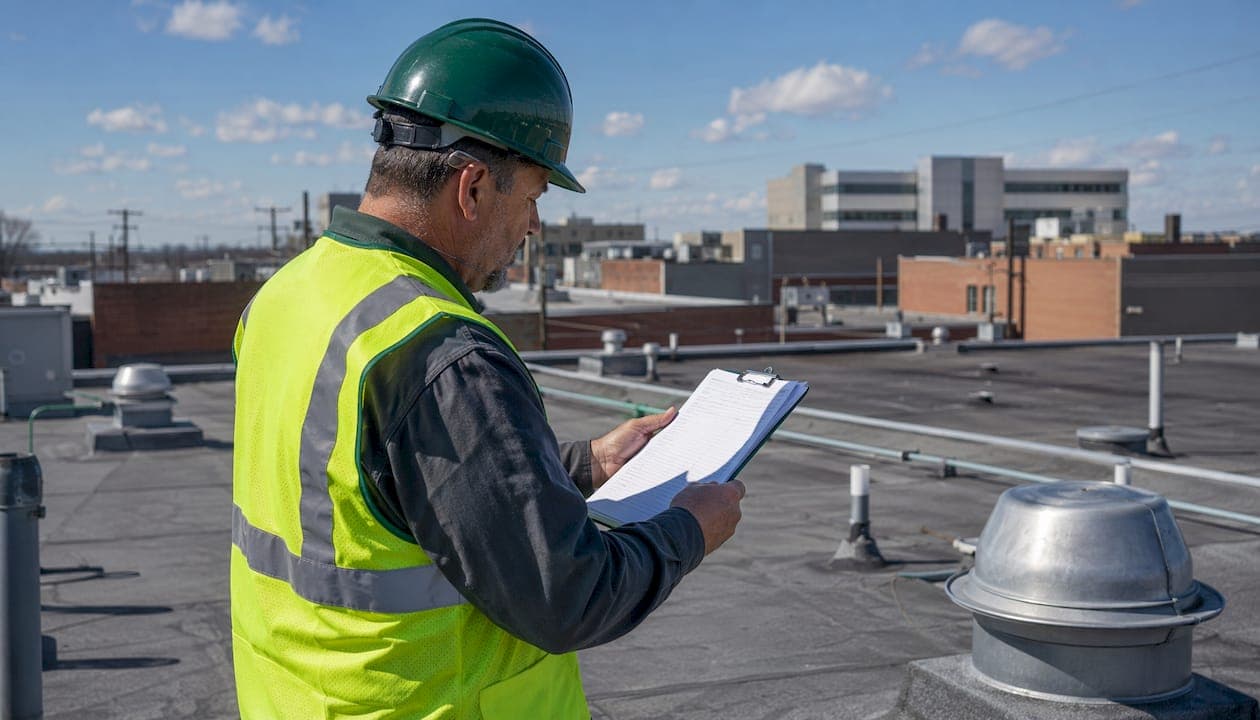
For any commercial property held longer than 24 months, a preventative roofing maintenance contract is the single most cost-effective tool you have to preserve manufacturer warranties, control repair spend, and avoid the kind of emergency that disrupts tenants and triggers insurance claims. The contract must include four non-negotiable components to be worth signing: a defined inspection cadence, a written emergency response SLA, a repair allowance with a stated dollar cap and scope, and photo-documented reports formatted for warranty and insurance use.

A full-service program typically runs $0.10–$0.25 per square foot per year and bundles inspections, drain and gutter service, a minor-repair allowance, and 24/7 emergency response. That price range covers real protection. Bare-bones inspection-only agreements at a lower per-square-foot price almost always leave out drain clearing and repair allowances, which means they frequently fail to satisfy manufacturer NDL warranty requirements. The difference between those two tiers is not just scope. It is whether your warranty survives an audit.
Chattanoogaroofrepairs works with property managers across Chattanooga and surrounding areas to build programs that check all four boxes, using manufacturer-backed materials from GAF and Owens Corning and delivering the documentation your warranty and insurance carrier actually need.
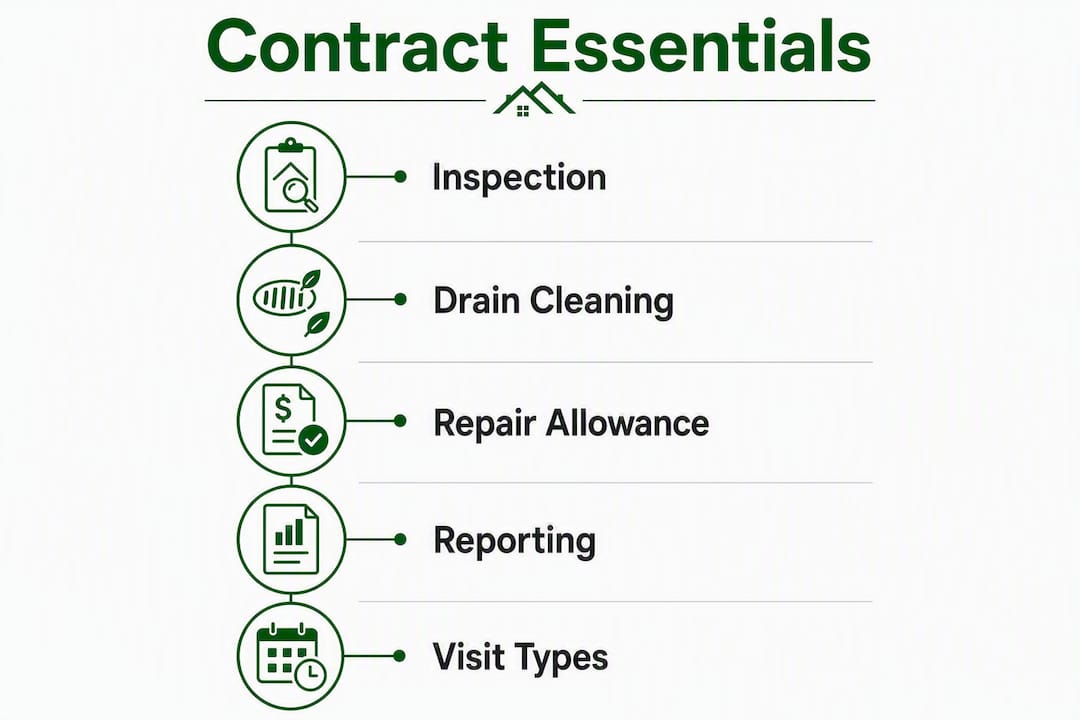
The four components that make a roofing maintenance contract real: scheduled visits with a defined cadence, a written emergency response window, a repair allowance with a stated dollar amount and scope, and photo-documented reports delivered within an agreed timeline after each visit. A contract missing any one of these is an inspection agreement, not a maintenance program.
Pro Tip: Insist on a named annual repair-allowance threshold in the contract itself, not just a verbal commitment. Industry guidance recommends a minimum of $1,500 per year for small sites, $2,500–$3,500 for mid-sized industrial buildings, and $5,000 for Class A portfolio buildings, with the allowance explicitly covering labor and specified materials such as fasteners, sealants, and patch stock.
Table of Contents
- What does a commercial roofing maintenance contract include?
- Why does a preventative maintenance contract pay off?
- How often should inspections happen, and what do they cover?
- How are maintenance contracts priced?
- What contract clauses should you negotiate before signing?
- Who pays, and how does lease structure affect the contract?
- How do you evaluate and select the right roofing contractor?
- When does a maintenance contract make sense, and when doesn't it?
- Key Takeaways
- Why a full preventative program is the right call
- Chattanoogaroofrepairs can build a maintenance program for your building
What does a commercial roofing maintenance contract include?
A well-written roof maintenance agreement names every service line explicitly. Vague scope language is the most common reason property managers end up paying for work they assumed was covered. Use the checklist below to compare proposals line by line.
Required contract line items
- Number and timing of visits: At minimum, two visual inspections per year (spring and fall). Premium tiers add quarterly visits or post-storm inspections.
- Drain and scupper clearing cadence: Twice-yearly drain clearing is the baseline for warranty-preserving programs; heavy-debris sites may need quarterly service.
- Emergency response window: A written SLA stating the maximum response time, whether that is four hours, eight hours, or next-business-day. Emergency response coverage typically adds $0.02–$0.05/sq ft to the annual fee when bundled into a full-service plan.
- Repair allowance: The annual dollar cap, what it covers (labor only vs. labor plus materials), and whether unused balances carry forward to the next contract year.
- Photo-documented reports: Delivery format (PDF, portal, email), required fields, and the deadline for delivery after each visit.
- Exclusions: What the contract explicitly does not cover (structural repairs, replacement of major components, damage caused by third parties).
- Contract term and renewal mechanics: Length, auto-renewal notice period, and cancellation terms.
- T&M rate card: The hourly labor rate and material markup for work that exceeds the repair allowance, so you can budget for overages without surprises.
Inspection report fields that satisfy NDL audits
Manufacturer NDL warranty audits commonly require documented inspection reports signed by a certified applicator or manufacturer-authorized contractor. Every report should include the fields in the table below.
| Report Field | Why It Matters |
|---|---|
| Inspector name and certification number | Required by most NDL audits; unsigned reports are frequently rejected |
| Date and building address | Establishes the service timeline for warranty compliance |
| Photos of all penetrations and flashings | Primary visual evidence of condition at time of inspection |
| Membrane condition rating by zone | Allows trend tracking across multiple visits |
| Deficiency log with roof plan references | Ties each finding to a specific location on the roof |
| Drain and scupper clearing confirmation | Documents that drainage maintenance was performed |
| Repair allowance charges with line-item detail | Supports CAM billing and insurance documentation |
| Signed completion statement | Satisfies warranty auditor signature requirements |
Pro Tip: Require named inspector credentials and a signature on every report. Many warranty audits accept only reports signed by certified applicators or contractors with manufacturer authorization. A report without a credentialed signature can void an NDL claim even when all the work was done correctly.
Why does a preventative maintenance contract pay off?
The financial case for a structured roof maintenance plan is straightforward. A maintenance contract can significantly increase usable roof life and deliver a substantial payback over a multi-year window compared to reactive-only repair approaches. For a property manager responsible for a building's long-term performance, that math is hard to ignore.
Core benefits include:
- Warranty preservation: Most manufacturer NDL warranties require documented, scheduled maintenance. Without it, a warranty claim can be denied outright.
- Extended roof life: Catching minor seam failures, ponding water, and flashing separations early prevents the kind of membrane degradation that accelerates replacement timelines.
- Predictable budgeting: A fixed annual fee with a defined repair allowance replaces unpredictable emergency invoices.
- Faster emergency response: Contracted clients typically receive priority dispatch ahead of one-time callers.
- Reduced tenant disruption: Proactive repairs happen on a schedule, not during a tenant's business hours after a ceiling tile collapses.
- CAM recovery and insurance documentation: Photo-documented reports give you the paper trail needed for pass-through billing and insurance compliance. Documented maintenance programs can also affect business insurance costs favorably.
Consider a simple comparison: a reactive leak repair on a mid-sized commercial building can run $3,000–$8,000 per event once you factor in emergency labor rates, temporary tarping, interior damage remediation, and tenant claims. A full-service annual program for the same building might cost $1,500–$3,000 per year. One avoided emergency event often covers two or three years of contract fees.
How often should inspections happen, and what do they cover?
The standard cadence for a commercial roof maintenance plan is twice per year: a spring visit after winter weather has done its damage, and a fall visit before storm season arrives. That baseline satisfies most manufacturer warranty requirements and catches the two periods when roofs are most vulnerable.
What inspectors should check at every visit: membrane condition across all zones, all flashings and penetrations (HVAC curbs, pipes, skylights), drain and scupper flow, seam integrity, ponding water locations, debris accumulation, and any visible signs of foot traffic damage. A visit that skips penetrations or drains is not a complete inspection.
Visit types and what each covers
| Visit Type | Timing | Primary Tasks |
|---|---|---|
| Spring inspection | March–April | Winter damage assessment, drain clearing, flashing and seam check, debris removal |
| Fall inspection | September–October | Pre-storm condition survey, drain clearing, sealant touch-ups, membrane survey |
| Post-storm inspection | Within 24–48 hours of event | Hail and wind damage documentation, emergency tarping if needed, insurance photo log |
| Premium quarterly visit | Year-round (4×/year) | All baseline tasks plus ponding water assessment and equipment penetration checks |
Post-storm inspections deserve a specific mention. They are not always included in standard twice-yearly programs, but they should be available as an on-call service with a defined response window. After a significant hail or wind event, the window for documenting damage before it worsens is short. Contractors who can deploy within 24–48 hours and deliver a photo-documented report suitable for an insurance claim are worth the premium.
Premium add-ons worth considering for high-value or aging roofs include infrared moisture scanning (which detects trapped moisture before it causes structural damage), drone imagery for large or complex roofs, and quarterly drainage programs for sites surrounded by heavy tree cover. A roof coating application is another lifecycle-extending measure that sometimes bundles into premium maintenance tiers.
Report delivery should be specified in the contract. A reasonable standard is a written, photo-documented report within five business days of each visit, delivered in PDF format with a copy retained in the contractor's portal.
How are maintenance contracts priced?
Most commercial roofing maintenance contracts are priced on a per-square-foot-per-year basis, which makes proposals easier to compare across buildings of different sizes. The table below shows the three common tiers and what each typically includes.
| Tier | Price Band ($/sq ft/year) | Repair Allowance | Emergency SLA |
|---|---|---|---|
| Inspection-only | $0.06–$0.10 | None | Not included |
| Standard (inspections + drains + allowance) | $0.10–$0.25 | $1,500–$3,500/year | Business-hours response |
| Full-service (all standard + 24/7 emergency) | $0.10–$0.25 | $3,500–$5,000/year | 24/7 with written SLA |
Warning: Inspection-only contracts priced at $0.06–$0.10/sq ft are the most common source of warranty disputes. They typically exclude drain clearing and carry no repair allowance, which means they do not meet the maintenance documentation standards most manufacturers require for NDL warranty compliance. Cheap per-square-foot pricing is not a deal. It is a gap in your warranty coverage.
Variables that push the price toward the higher end of each band include:
- Older roof systems (15+ years) that require more attention per visit
- Complex access (multi-level buildings, equipment-dense rooftops)
- Multiple buildings on a single site managed under one contract
- Geographic regions with higher labor rates
- Inclusion of 24/7 emergency response or portal-based reporting
- Roof system type (metal and modified bitumen systems often require more specialized labor than single-ply)
Flat annual fees are also common for smaller buildings or single-location owners. These are straightforward to budget but harder to compare across providers without knowing the square footage basis. Always ask for the per-square-foot equivalent when evaluating a flat-fee proposal.
What contract clauses should you negotiate before signing?
A roofing maintenance agreement is a service contract, and like any service contract, the terms you negotiate upfront determine whether it protects you or the contractor. These are the clauses that matter most.
Must-have clauses:
- Defined visit cadence: Specific months or seasonal windows, not just "twice per year."
- Named emergency response window: A written SLA stating the maximum hours to first response and the maximum hours to temporary protection (tarping).
- Repair allowance amount and carryover policy: The annual dollar cap, what it covers (labor and materials vs. labor only), and whether unused balances roll forward. Well-written contracts include carryover provisions and explicit lists of what the allowance covers to prevent recurring change orders.
- Scope definition for the allowance: Fasteners, sealants, and patch materials should be named explicitly. "Labor only" allowances shift material costs back to you on every repair.
- Exclusions: Clearly stated, not buried in fine print.
- Report delivery format and timeline: PDF with photos, delivered within a specified number of business days.
- Term length and renewal mechanics: Auto-renewal is standard, but the cancellation notice window should be at least 30 days and clearly stated.
- T&M rate card: The hourly rate and material markup for work beyond the allowance, locked in for the contract term.
Red flags to walk away from: vague scope language that does not name specific services, refusal to commit to a written emergency response SLA, a repair allowance below $500 per visit (which causes constant change orders and defeats the predictability the contract is supposed to provide), auto-renewal clauses with cancellation windows shorter than 30 days, and clauses that require you to use the same contractor for any future replacement work.
Pro Tip: Negotiate the repair allowance to at least $1,500 annually for small sites. For mid-sized industrial buildings, $2,500–$3,500 is the typical range. For Class A portfolio buildings, $5,000 is common. Require the allowance to cover both labor and specified materials so you are not hit with a separate materials invoice every time a repair is made.
Who pays, and how does lease structure affect the contract?
In a triple-net (NNN) lease, the lease language typically makes roof maintenance the tenant's responsibility or allows the landlord to pass it through as a common area maintenance (CAM) expense. In modified gross and full-service leases, the cost usually stays with the landlord. Knowing which structure applies to each building determines who signs the maintenance contract and who funds it.
For landlords recovering costs through CAM, the maintenance contract must generate documentation that supports itemized billing. Tenants have the right to audit CAM charges in most NNN leases, so vague invoices create disputes.
Documentation fields required for CAM pass-through billing
| Field | Purpose |
|---|---|
| Service date and building address | Establishes when and where work was performed |
| Work performed (line-item detail) | Supports itemized CAM billing |
| Time on site | Verifies labor charges |
| Repair allowance charges with material breakdown | Allows tenant audit of material costs |
| Inspector name and certification | Confirms qualified personnel performed the work |
| Signed completion statement | Provides legal confirmation of service delivery |
NNN lease structures require itemized reports that simplify CAM pass-through billing. A contractor who delivers a single-line invoice ("roof maintenance services — $X") is not giving you what you need. The contract should specify the exact reporting format, and you should confirm the contractor can deliver it before signing.
Practical tips for multi-tenant buildings:
- Specify in the maintenance contract that all reports are formatted for CAM accounting.
- Use a tenant repair request tracking system to cross-reference contractor visit logs with tenant-reported issues.
- Avoid situations where a tenant contracts their own roof work on a landlord-owned roof. Conflicting coverage creates warranty gaps and liability disputes. The maintenance contract should include a clause addressing tenant-initiated roof access.
How do you evaluate and select the right roofing contractor?
Not every contractor who offers a maintenance program can actually deliver one that preserves your warranty. Use a structured evaluation process before you commit.
Contractor evaluation checklist
- Verify licensing and insurance. The contractor must carry general liability and workers' compensation coverage appropriate for commercial work in your state.
- Confirm manufacturer certifications. For GAF-warranted roofs, look for GAF-certified contractors. For Owens Corning systems, verify Owens Corning certification. These credentials are required for warranty-compliant work.
- Request local references from similar building types. A contractor who maintains retail strip centers may not have experience with Class A office buildings or industrial facilities.
- Review a sample inspection report. Ask for a redacted example from a recent inspection. If it lacks photos of penetrations, a deficiency log, and a signed completion statement, the reporting will not satisfy an NDL audit.
- Confirm emergency response capacity. Ask how many crews are available for emergency dispatch and what the realistic response time is during a major storm event when multiple clients call simultaneously.
- Ask for the T&M rate card in writing. Contractors who refuse to commit to a locked rate for work beyond the allowance will charge market rate at the time of the repair, which eliminates budget predictability.
- Review cancellation terms. A fair contract allows either party to cancel with 30 days' written notice and no early-termination penalty.
Red flags during proposals:
- Scope described in general terms without named services
- No written emergency response SLA offered
- Repair allowance below the industry-standard minimum for your building size
- Refusal to provide photo-documented reports or sample reports on request
- Pressure to sign a multi-year agreement with no cancellation option
When does a maintenance contract make sense, and when doesn't it?
A roofing maintenance contract is most effective for buildings expected to be held long term (10 or more years) or properties larger than roughly 5,000 sq ft. For those assets, the warranty preservation value alone often justifies the annual spend before you factor in lifecycle extension.
There are edge cases where reactive, on-call repairs are the better choice:
- Buildings scheduled for sale within 24 months, where the capital is better preserved for the transaction
- Roofs due for full replacement within 2–3 years, where maintenance spend yields diminishing returns
- Very small buildings with simple roof systems and no active manufacturer warranty to protect
Pro Tip: Run a simple ROI check before deciding. Multiply your roof's square footage by your recent average annual repair spend. If that number exceeds the cost of a full-service program for the same square footage, the contract pays for itself on spend reduction alone, before you count warranty preservation or lifecycle extension.
Factors to weigh when making the decision:
- Roof age: Systems under 5 years old with active NDL warranties have the most to lose from undocumented maintenance.
- Warranty status: An active manufacturer warranty that requires documented maintenance makes a contract nearly mandatory.
- Lease structure: NNN leases with CAM pass-through make the cost recoverable, which changes the economics significantly.
- Tenant exposure: High-occupancy buildings where a roof failure disrupts multiple tenants raise the cost of a reactive approach considerably.
- Ownership horizon: Long-term holders benefit most. Short-term holders should weigh the contract cost against the remaining hold period.
Key Takeaways
A full-service roofing maintenance contract, covering inspections, drain clearing, a defined repair allowance, and photo-documented reports, is the most reliable way to preserve manufacturer warranties and control long-term roof spend for commercial properties held beyond 24 months.
| Point | Details |
|---|---|
| Four required components | Every contract must name a visit cadence, emergency SLA, repair allowance with scope, and photo-documented report format. |
| Pricing tiers matter | Full-service programs run at a moderate per-square-foot cost per year; inspection-only contracts at a lower per-square-foot price typically do not preserve NDL warranties. |
| Repair allowance minimums | Negotiate at least $1,500/year for small sites; $2,500–$3,500 for mid-sized industrial; $5,000 for Class A buildings. |
| Lifecycle impact | Maintenance contracts significantly extend roof life and deliver substantial payback over a multi-year window versus reactive-only approaches. |
| Chattanoogaroofrepairs | Offers twice-yearly inspections, drain clearing, defined repair allowances, and photo-documented reports using GAF and Owens Corning materials. |
Before you sign, confirm:
- Visit cadence is stated by season or month, not just frequency
- Repair allowance covers labor and named materials, with a carryover clause
- Emergency SLA is written into the contract with a specific response window
- Reports include all required fields for warranty and CAM documentation
- Manufacturer warranty preservation language is explicit in the scope
Why a full preventative program is the right call
Most property managers I work with come to the same conclusion once they see a denied warranty claim or a $6,000 emergency repair invoice: the annual cost of a real maintenance program is not the expense they thought it was. It is the cheaper option. The math is not complicated. What trips people up is the assumption that an inspection-only contract counts as maintenance. It does not. An inspector who walks the roof, takes a few photos, and sends a summary report has not cleared your drains, touched your flashings, or given you a repair allowance to address the three small issues they found. You still have to call someone, negotiate a price, and wait for scheduling. That is reactive maintenance with an inspection fee attached.
The contracts worth signing are the ones that commit the contractor to showing up twice a year, clearing every drain, addressing minor repairs on the spot within the allowance, and delivering a signed, photo-documented report within five business days. Those are the programs that satisfy GAF and Owens Corning warranty auditors, hold up in insurance claims, and give you something concrete to show a tenant or an owner when they ask what you spent the maintenance budget on.
Chattanoogaroofrepairs can build a maintenance program for your building
Skip the guesswork of comparing vague proposals. Chattanoogaroofrepairs delivers structured commercial maintenance programs for property managers in Chattanooga and surrounding areas, with twice-yearly inspections, drain and gutter clearing, a defined repair allowance, and photo-documented reports formatted for warranty audits and CAM billing.
Every program uses manufacturer-backed materials from GAF and Owens Corning, and our 21-point inspection process covers every penetration, flashing, drain, and membrane zone on your roof. We offer same-day emergency tarping for storm events and 24/7 response for contracted clients. If an inspection finds a leak, our roof leak repair team can address it immediately, without a separate scheduling cycle. Our gutter installation and repair services are also available as part of a bundled drainage program. Contact us to request a no-pressure site survey and a tailored maintenance proposal for your building.