
The fastest way to track roof repair requests from tenants is a dated digital ticket that captures the tenant's contact information, property ID, exact leak location, timestamped photos, urgency level, and a follow-up SLA. That single record protects your insurance options, preserves manufacturer warranty eligibility, and starts the clock on repairs before damage spreads.
Urgent next steps once a report comes in:
- Confirm tenant safety and ask for photos immediately (interior stain, exterior roof, and any active drip).
- Open a new ticket and fill in every required field before doing anything else.
- If water is actively entering the home, schedule same-day tarping. Chattanooga Roof Repair Pros offers emergency tarping for exactly this situation.
- Notify your insurer if the report follows a storm or sudden structural event.
Properties that use structured digital workflows report improved tenant satisfaction by 35% and reduce request-to-resolution time by 50% compared with phone or email-based processes. A 21-point roof inspection, completed before or immediately after repairs, gives you the documented baseline that adjusters and manufacturers need.
Pro Tip: Set up your ticket system before the next storm season. Chattanooga's spring weather moves fast, and a blank template ready to fill beats scrambling for a notepad when a tenant calls at 10 PM.
Table of Contents
- What should you collect from a tenant when they report a roof issue?
- How do you set up a simple system to log every tenant repair request?
- How do you triage a roof report: emergency vs. routine?
- What documentation do insurers and manufacturers actually require?
- When does your inspection checklist say repair, and when does it say replace?
- How do you track contractors, invoices, and follow-up work?
- Copy-ready templates to acknowledge, update, and close tenant tickets
- Key Takeaways
- What most landlords get wrong about roof documentation
- Chattanooga Roof Repair Pros is ready when you need fast, documented help
What should you collect from a tenant when they report a roof issue?
The evidence you gather in the first hour often determines whether an insurance claim succeeds or a warranty stays valid. Ask tenants to send you all of the following before you close the conversation.
Photo and video set to request:
- Close-up of the interior stain or wet area, with a date stamp visible
- Wider interior shot showing the stain's position relative to walls, fixtures, or vents
- Exterior roof photos from two angles (ground level is fine; never ask a tenant to climb)
- Attic or underside photos if the tenant can safely access the space
- A short video of any active drip or running water, timestamped
Contextual details to capture:
- Date and time the tenant first noticed the issue
- Weather conditions at the time (recent storm, heavy rain, hail)
- How the problem presents: drip, stain growth, water running along a beam
- Whether any utilities, electrical outlets, or HVAC equipment are near the wet area
Capture the context, not just the damage. A photo of a ceiling stain tells a contractor where to look. A photo of the same stain paired with a note that it appeared two hours after a hailstorm tells an adjuster what caused it. Both pieces together are what preserve your claim.
You can send tenants this short prompt to make collection consistent:
"Please send: (1) your unit number and the room where you see the issue, (2) three photos — a close-up, a wider shot, and one from outside if possible, (3) a note on when you first noticed it and whether it's still active. Reply to this message and we'll confirm receipt within the hour."
Common defects like flashing failure and granule loss often look identical from the inside. Dated photos from multiple angles give a licensed contractor the context to diagnose correctly rather than guess.
How do you set up a simple system to log every tenant repair request?
A spreadsheet works fine for a single property. A cloud-based sheet with a shared photo folder handles a small portfolio. For owners managing multiple properties, AI-enabled maintenance software can triage tickets automatically, identify the right trade, and reduce manual coordination time from minutes to seconds per ticket.

Whichever tool you use, every ticket needs the same core fields.
| Field | Description | Example Value |
|---|---|---|
| Property ID | Unique identifier for the address | CHATT-— |
| Unit | Apartment or area within the property | Unit 2B |
| Tenant name | Primary contact for the report | J. Williams |
| Contact | Phone and email | — |
| Report date/time | When the tenant submitted the issue | June 3, 2026, 9:14 PM |
| Photo links | Cloud folder or attachment URLs | drive.google.com/… |
| Roof location | Where on the roof the issue appears | NW corner, above kitchen |
| Urgency | Emergency / High / Routine | Emergency |
| Assigned contractor | Company name and license number | Chattanooga Roof Repair Pros |
| SLA target | Deadline for on-site assessment | June 4, 2026 |
| Cost | Estimate and final invoice amount | — |
| Invoice link | Document storage URL | drive.google.com/… |
| Warranty notes | Material brand, warranty type, expiration | GAF Timberline, limited |
Platforms like RentMouse let tenants submit requests with photos directly through a portal, auto-stamp the ticket, and route it to the right vendor. That removes the manual intake step entirely for landlords managing more than two or three units.
How do you triage a roof report: emergency vs. routine?
Not every wet ceiling is a crisis, but some are. Getting this call right protects the tenant and limits your repair cost.
Emergency keywords and situations requiring same-day action:
- Active water dripping or running inside the home
- Visible sagging or soft spots in the ceiling
- Water near electrical panels, outlets, or HVAC equipment
- Large exposed area after storm damage (missing shingles, open decking)
Triage steps in order:
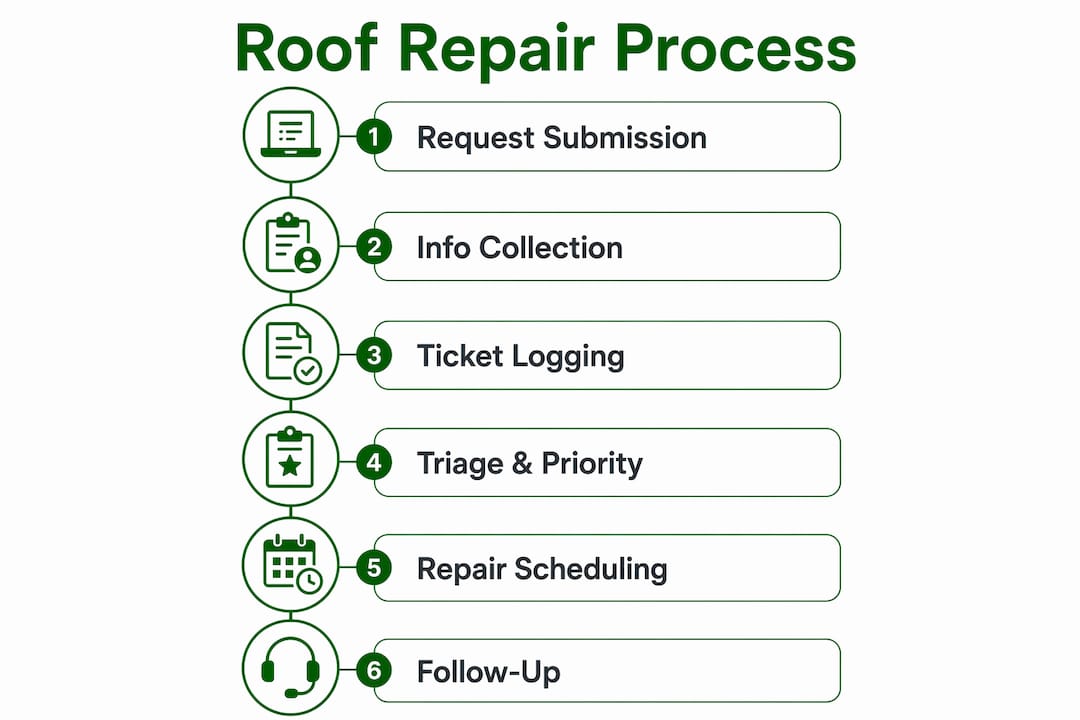
- Receive the report and auto-acknowledge within one hour.
- Review photos and apply the urgency criteria above.
- For emergencies: dispatch a contractor for same-day tarping and on-site assessment. For a storm-damaged roof, never send a tenant or unqualified person onto the roof.
- For high-priority (non-emergency) reports: schedule an on-site assessment within 24 hours.
- For routine reports (minor stain, no active leak): schedule within 3–14 days depending on season and weather forecast.
- Update the ticket status and notify the tenant at each stage.
Properties using structured tenant workflows significantly cut resolution time. That speed matters most in Chattanooga's storm season, when multiple properties can report damage within hours of each other.
Statistic callout: Properties with digital maintenance workflows report substantial reductions in request-to-resolution time and higher tenant satisfaction versus unstructured phone or email processes.
What documentation do insurers and manufacturers actually require?
Getting the repair done is only half the job. Without the right paperwork, a valid claim can be denied or a warranty voided.
- Dated ticket with report time, tenant name, and property address
- Timestamped photos of interior damage and exterior roof condition (taken before any repair work begins)
- Contractor name, license number, and proof of insurance
- Itemized written estimate and final signed invoice
- Materials used: manufacturer name, product line, and part or model numbers (GAF or Owens Corning product details, for example)
- Pre-repair inspection report, ideally a 21-point inspection completed by a licensed contractor
- Any manufacturer notification confirmation, if required by the warranty terms
Many manufacturer warranties require prior notification before repairs begin and mandate that work be completed by an approved contractor. Skipping either step can void coverage even when the defect is legitimate. Contact your insurer promptly after any suspected storm damage. Quick notification can affect how an adjuster evaluates your claim, and most policies expect you to take reasonable steps to prevent further damage, which is exactly what tarping accomplishes. For a full walkthrough of the claim process, the roof damage insurance claim steps guide covers each stage in detail.
When does your inspection checklist say repair, and when does it say replace?
A 21-point inspection gives you the evidence to answer that question with facts rather than guesswork. The condensed checklist covers:
- Shingle or covering condition (cracking, curling, missing sections)
- Flashing integrity at valleys, chimneys, and penetrations
- Gutter and drainage performance
- Roof deck condition (soft spots, rot, delamination)
- Granule loss (bare patches on asphalt shingles)
- Ponding or standing water areas
- Interior evidence of water travel (stain patterns, mold, efflorescence)
- Ventilation adequacy (ridge vents, soffit vents)
- Age of materials relative to manufacturer lifespan
- Scope and frequency of prior patching
Replacement threshold: When the same defect recurs within 12–24 months, when patching covers more than a localized area, or when deck rot is present, repair costs typically exceed the value of extending the roof's life. Those inspection findings, documented in the ticket record, give you an evidence-based case for replacement rather than another round of patches. The repair vs. replacement criteria guide walks through the specific thresholds in detail.
Water migrates. An interior stain rarely marks the entry point, which is why a professional diagnostic inspection is necessary before approving multiple patch repairs on the same area.
Pro Tip: Schedule at least two inspections per year, spring and fall, to catch freeze-thaw damage before winter and storm damage before summer. Add the dates to your ticket system as recurring entries so they never slip.
How do you track contractors, invoices, and follow-up work?
Every contractor you hire should have a record in your system before work begins. Log the following for each job:
- Company name and registered business name
- License number and state of issue
- Proof of insurance (general liability and workers' comp)
- Contact name and phone
- Date of work and scope description
- Materials used (brand, product line, model)
- Warranty terms and transferability
- Invoice link and payment confirmation
Questions to ask before approving any work: Does your license cover this type of repair in Tennessee? What materials will you use, and are they manufacturer-approved? What is your tarping plan if the repair takes more than one day? Do you provide a written warranty on labor?
Red flags to watch for: no written estimate before work starts, cash-only payment requests, refusal to provide license or insurance documentation, vague warranty language ("we stand behind our work" with no defined term), or a business name that does not match the license on file.
Copy-ready templates to acknowledge, update, and close tenant tickets
Clear, fast communication reduces follow-up calls and shows tenants the issue is being handled. Save each message in the ticket record.
Acknowledgment (send within one hour of receiving the report):
"Hi [Tenant Name], we received your roof repair report for [unit/address] at [time]. We're reviewing the photos now and will confirm next steps within [X hours]. Ticket ID: [#]. Reply to this message with any updates."
Triage/appointment confirmation:
"Hi [Tenant Name], we've reviewed your report. A licensed contractor will assess the issue on [date] between [time window]. If the situation changes before then — especially if water is actively entering the home — reply here immediately and we'll escalate."
Completion/close:
"Hi [Tenant Name], the repair at [unit/address] is complete as of [date]. Invoice and warranty documentation are on file. If you notice any recurrence, please report it right away using the same process."
Keep every message in the ticket. A complete communication trail — from first report to close — is the record an adjuster or attorney will ask for if a dispute arises later. Attach photo documentation to the ticket alongside each message.
Emergency escalation note (for insurer): "We received a report of active water intrusion at [address] on [date/time] following [weather event]. Emergency tarping was dispatched same-day. Photos and contractor documentation are attached. Claim notification submitted: [date]."
Key Takeaways
A dated digital ticket with photos, urgency level, and contractor records is the single most effective way to protect your insurance claim, preserve warranty coverage, and resolve tenant roof issues faster.
| Point | Details |
|---|---|
| Create a dated ticket immediately | Log property ID, photos, urgency, and SLA before any other step. |
| Triage for same-day tarping | Active leaks, sagging, or storm exposure require same-day contractor dispatch. |
| Document for insurance and warranty | Timestamped photos, contractor license, and materials used are required by most insurers and manufacturers. |
| Use the inspection checklist | A 21-point inspection identifies when repeated repairs signal replacement, not another patch. |
| Chattanoogaroofrepairs for Chattanooga | Chattanoogaroofrepairs provides emergency tarping, 21-point inspections, and full documentation support for local homeowners. |
What most landlords get wrong about roof documentation
Most landlords treat roof repairs as a one-time transaction: call a contractor, pay the invoice, move on. The problem is that the next storm, the next claim, or the next tenant dispute will ask for records that no longer exist.
The 21-point inspection is not just a marketing term. It is a structured diagnostic that separates surface symptoms from root causes. An interior stain can travel six feet from its entry point before it shows up on a ceiling. Without a professional inspection that traces the water path, you end up patching the wrong spot repeatedly, which is exactly the scenario that leads to a replacement conversation two years earlier than necessary.
Tenants are genuinely the best early-warning system a landlord has. A small drip reported on day one costs a fraction of what the same leak costs after three months of undetected migration through the deck. The landlords who build that into their process — a simple, low-friction way for tenants to report small issues — consistently avoid the large emergency repairs that drain budgets and strain relationships.
The documentation habit is also what separates a smooth insurance claim from a denied one. Adjusters want a timeline: when did the damage occur, what was done immediately, who did the work, and what materials were used. A complete ticket record answers every one of those questions before the adjuster asks.
Chattanooga Roof Repair Pros is ready when you need fast, documented help
When a tenant reports an active leak or storm damage, you need a licensed contractor who can respond the same day, document everything correctly, and give you the paperwork your insurer expects. That is exactly what Chattanoogaroofrepairs delivers for homeowners across Chattanooga and the surrounding area.
Chattanoogaroofrepairs offers emergency tarping, roof leak repair, 21-point inspections, and full documentation packages that include dated photos, contractor credentials, and material records. GAF and Owens Corning certified materials mean your repair meets manufacturer warranty requirements from the start. Before you call, have your ticket ID or photos ready, the property address, tenant contact information, and any recent weather event details. On first contact, you will get a clear assessment window, a walkthrough of what the inspection covers, and confirmation of what documentation will be delivered. To see the full range of roofing services available, or to schedule an inspection today, reach out to the Chattanoogaroofrepairs team directly.