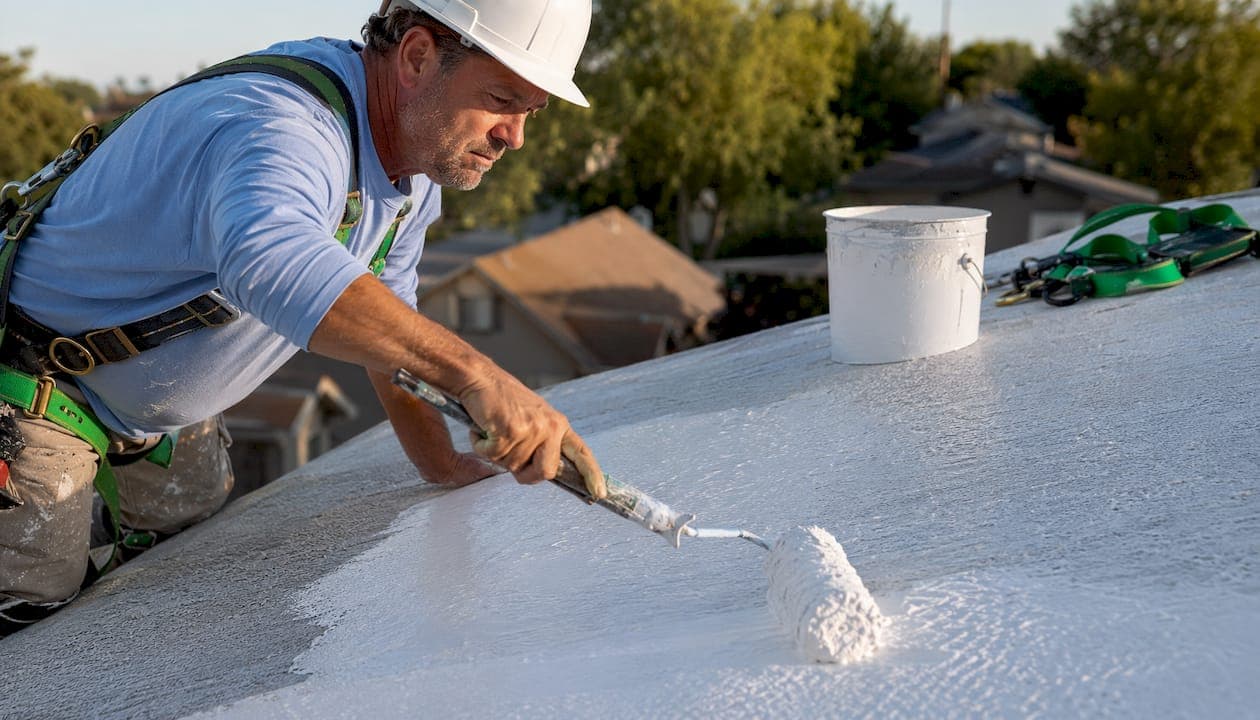
A roof coating application is a fluid-applied, monolithic membrane bonded directly to an existing, structurally sound roof surface to protect it from water intrusion, UV degradation, and heat. Done correctly, it can add significant additional years to a roof's service life and cut cooling costs significantly. The three roof types that most commonly qualify are:
- Low-slope commercial membranes (TPO, EPDM, modified bitumen)
- Metal roofs with intact seams and sound substrate
- Built-up roofs (BUR) that have been properly cleaned and repaired
Table of Contents
- What is a roof coating application, and how does it differ from paint or replacement?
- How does a roof coating actually protect your roof?
- Which coating chemistry is right for your roof?
- What are the real benefits of roof coating for property owners?
- When coatings are not the right answer
- How to apply a roof coating: the step-by-step process
- What tools and equipment does a professional bring?
- What does a roof coating cost, and how long will it last?
- Should you DIY or hire a professional?
- Research-backed performance data for U.S. property owners
- Key Takeaways
- The coating decision most property owners get wrong
- Chattanoogaroofrepairs can handle your coating project from inspection to warranty
- Useful sources and documents to request before you start
What is a roof coating application, and how does it differ from paint or replacement?
A roof coating is a performance membrane, not a cosmetic product. Paint sits on the surface and provides color or minor weather resistance. A coating bonds fully to the substrate, cures into a flexible, waterproof film, and becomes the topmost protective layer of the roof system. Dry film thickness typically ranges from a few mils (similar to heavy paint) up to a thicker protective layer, depending on the system. That thickness is what separates a coating from a coat of paint.
Coating versus full replacement is a different question entirely. Replacement means tearing off existing layers, disposing of old materials, and installing a new roof system. A coating is a restoration strategy: it preserves the existing membrane, seals minor vulnerabilities, and defers a costly tear-off. The IBC clarified in 2018 and 2021 that applying a coating over an existing roof is permitted without forcing a full tear-off in many cases, though local code and manufacturer intent still affect classification. If your roof substrate is wet, structurally compromised, or heavily deteriorated, replacement is the right call. If the substrate is sound and dry, a coating can be a financially smart alternative.
How does a roof coating actually protect your roof?
Coatings work through three mechanisms: physical sealing, elastomeric flexibility, and solar reflectance.
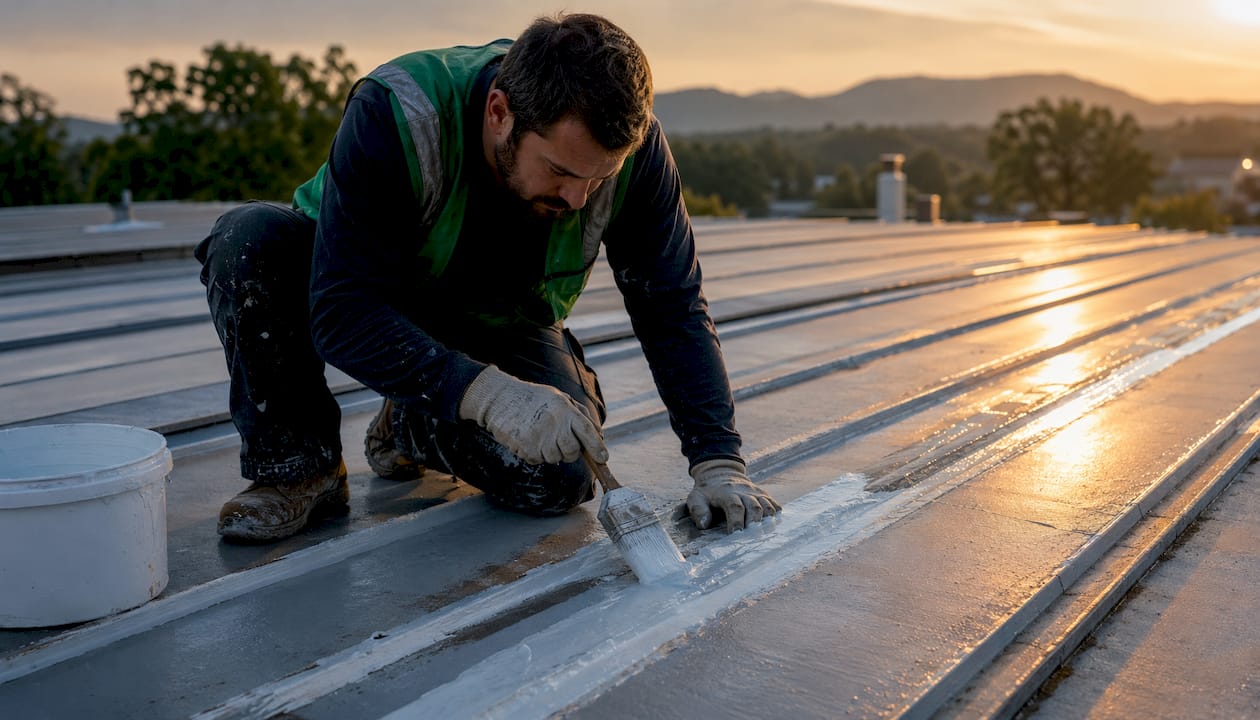
When applied as a liquid, the coating flows into seams, around flashings, and over penetrations, curing into a seamless, fully adhered membrane. There are no laps or seams to fail. That monolithic quality is what makes a properly applied coating so effective at stopping water intrusion at the exact points where most roofs eventually leak.
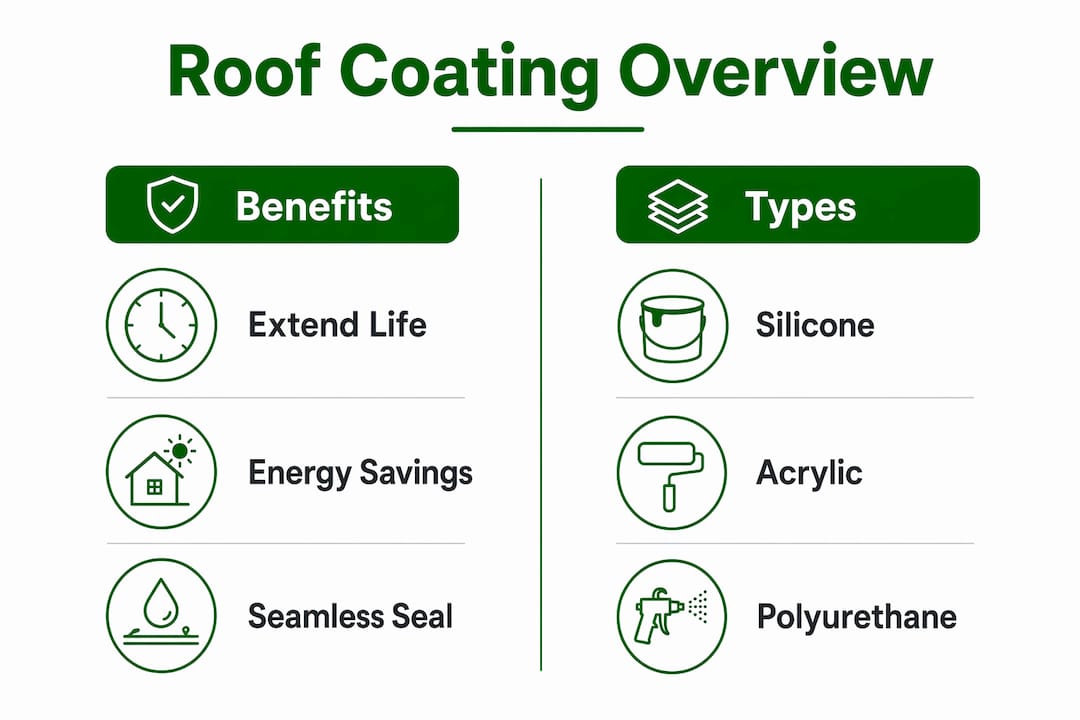
Elastomeric coatings stretch and return to their original shape without cracking. This matters because roofing membranes expand and contract daily with temperature swings. A coating that can bridge minor cracks and movement joints keeps the membrane intact through those cycles. That said, elastomeric properties have limits: coatings are not designed to bridge large structural gaps or span open seams that should be mechanically repaired first.
The third mechanism is solar reflectance. White and light-colored coatings reflect sunlight rather than absorbing it, which directly reduces roof surface temperature and the heat load transferred into the building below.
- Seamless membrane: eliminates lap seams and exposed fasteners as leak points
- Elastomeric film: bridges minor cracks and accommodates thermal movement
- High solar reflectance: reduces surface temperature and HVAC cooling demand
- Mil thickness: dry film of 20–40 mils provides meaningful waterproofing; thinner applications are better suited to UV protection only
Statistic: Reflective white coatings can reflect more than 80% of solar energy and reduce roof surface temperatures by 50–80°F on hot days.
Which coating chemistry is right for your roof?
Matching the chemistry to your roof conditions is as important as the application itself. The table below summarizes the four primary systems.
| Chemistry | Best Use Case | Key Pros | Key Cons | Typical Warranty |
|---|---|---|---|---|
| Silicone | Flat roofs with ponding water | Moisture-cure, UV stable, holds up in standing water | Attracts dirt, hard to recoat, slippery when wet | 10–20 years NDL |
| Acrylic | Well-drained, sunny climates | Low cost, easy application, good reflectivity | Softens in standing water, not for ponding roofs | 5–15 years |
| Polyurethane | High-traffic roofs, impact-prone areas | Excellent abrasion and impact resistance | Higher cost, moisture-sensitive during cure | 10–20 years NDL |
| Asphaltic/Bituminous | BUR and modified bitumen substrates | Compatible with asphalt systems, good adhesion | Low reflectivity, limited energy benefit | 5–10 years |
Silicone coatings are moisture-cure systems, which means they cure by reacting with atmospheric humidity after application. That makes them ideal for flat roofs where water pools after rain. One important caveat: the substrate itself must be dry before application, even though the cured coating handles ponding well. Silicone versus acrylic versus polyurethane is ultimately a question of your roof's drainage, traffic load, and climate. Always check the manufacturer's Product Data Sheet (PDS) for substrate compatibility and primer requirements before specifying a system.
What are the real benefits of roof coating for property owners?
The financial case for coating a sound roof is straightforward. A full commercial roof replacement can run $10–$30 per square foot or more depending on the system and region. A quality coating system typically costs a fraction of that, and when correctly installed, it can carry a multi-year No Dollar Limit (NDL) manufacturer warranty, turning an aging roof into a performing asset.
- Extended service life: delays tear-off by 10–20 years when the substrate qualifies
- Energy savings: reduced surface temperatures lower HVAC cooling loads, with up to 50% energy reduction in certain building designs and climates
- Reduced landfill waste: no tear-off means no shingles or membrane in the landfill
- Minimal disruption: most coating projects allow the building to remain occupied
- Potential tax advantage: the IRS has treated roof coatings as maintenance in many cases, which may allow property owners to expense the cost in the year of application rather than depreciate it over 39 years as a capital improvement — consult a tax advisor for your specific situation
- Improved aesthetics: a fresh white coating restores appearance and can improve slip resistance on walkable surfaces
The energy benefit deserves a direct look. A roof surface on a hot summer afternoon can drop significantly with a high-reflectance coating applied. That temperature difference translates directly into reduced heat transfer through the roof deck and lower air conditioning demand. For a large commercial building in a hot climate like Chattanooga's, that reduction adds up quickly across a cooling season.
When coatings are not the right answer
Coatings restore and waterproof a sound roof. They do not fix structural problems, and applying one over a compromised substrate is one of the most common and costly mistakes in commercial roofing.
Conditions that rule out coating as the primary solution:
- Active leaks: water is entering the building now; the source must be found and repaired first
- Wet or damp insulation: trapped moisture under a coating will cause blistering and adhesion failure
- Severely deteriorated membranes: cracked, brittle, or heavily alligatored surfaces cannot hold a coating
- Standard asphalt shingles: most residential shingle roofs are not suitable candidates for fluid-applied coatings
- Incompatible substrates: some coatings will not adhere to certain primers or existing coatings without specific preparation
Statistic: About 80% of coating failures are caused by poor surface preparation or improper application techniques, not product defects.
Before any coating project begins, a qualified inspector should perform a moisture survey (infrared scan or nuclear gauge) to confirm the insulation is dry, check for open seams and broken flashings, and verify that the membrane has enough remaining integrity to hold adhesion. If any of those checks fail, repair comes first. Chattanoogaroofrepairs recommends reviewing signs of storm damage before scheduling a coating evaluation, since storm events often introduce the wet insulation and punctures that disqualify a roof.
How to apply a roof coating: the step-by-step process
A correct roof coating installation follows a defined sequence. Skipping steps, particularly surface prep and mil verification, is the primary reason coatings fail prematurely.
- Inspection and moisture survey: walk the roof, probe suspect areas, and conduct an infrared or nuclear moisture scan to confirm dry insulation throughout.
- Substrate repairs: seal all open seams, replace broken or lifted flashings, and repair any punctures or blisters before any coating material is applied.
- Surface cleaning: pressure wash at 2,500–3,500 PSI to remove dirt, biological growth, and oxidation. Grease or oil contamination requires solvent cleaning before washing.
- Priming: apply the manufacturer-specified primer where required (metal substrates, certain EPDM surfaces, and areas with adhesion concerns). Allow full cure per the PDS.
- Seam and flashing reinforcement: embed polyester fabric or fiberglass mesh into a base coat at all seams, flashings, and penetrations. This is the most labor-intensive step and the most important for long-term performance.
- First coat application: apply at the manufacturer's specified wet film thickness using an airless sprayer or heavy-nap roller. Check wet film thickness with a wet film gauge during application.
- Second coat (cross-hatch): apply the second coat perpendicular to the first. This cross-hatch technique eliminates pinholes and thin spots that a single-direction pass leaves behind.
- Cure and QA: allow full cure per the PDS weather window, then verify dry film thickness with a dry film gauge. Conduct adhesion testing per the manufacturer's protocol.
| Application Stage | Key Measurement | Typical Target |
|---|---|---|
| Surface cleaning | Pressure | 2,500–3,500 PSI |
| Wet film (each coat) | Wet mil gauge reading | Per product PDS |
| Dry film (total system) | Dry mil gauge reading | a thickness depending on the system |
| Cure window | Temperature / humidity | Min. 50°F, no rain within 24 hrs |
| Adhesion test | Pull-off strength | Per manufacturer spec |
Pro Tip: Always check wet film thickness during application with a comb-style wet film gauge — don't wait until the coating has cured to discover you applied it too thin. Under-application is the leading cause of premature failure and warranty disputes. Verify dry film readings after cure as a final QA step.
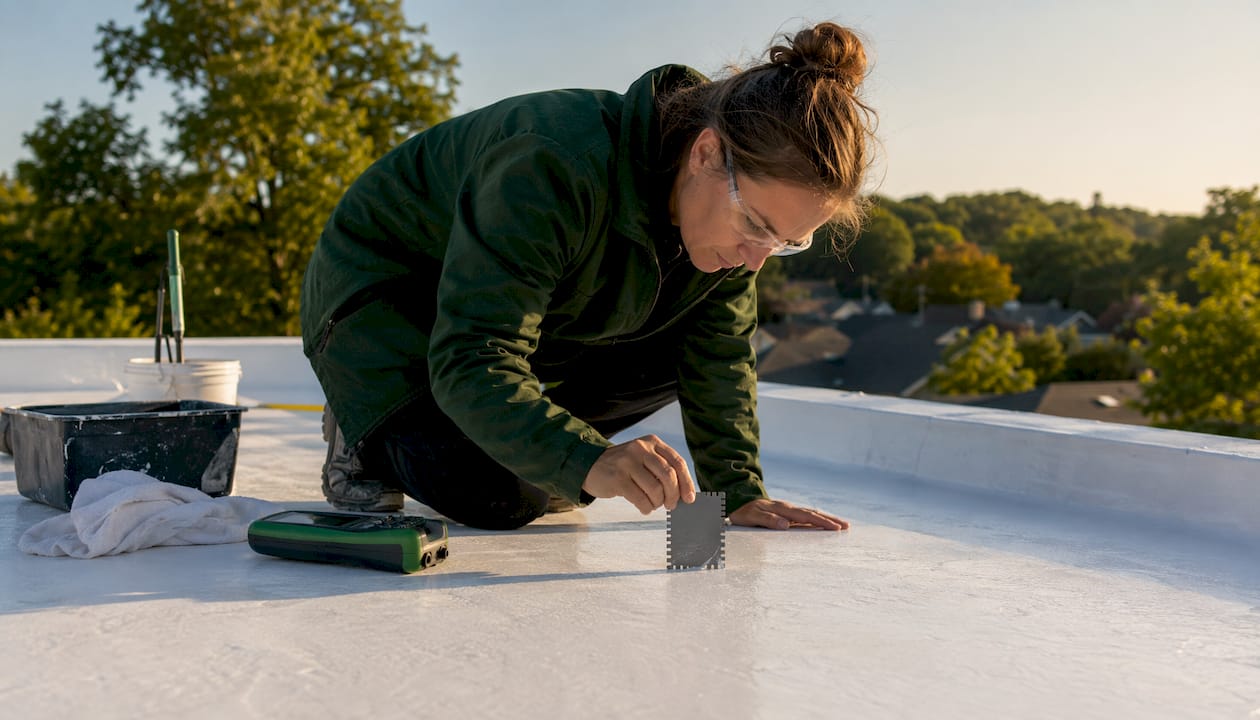
Weather scheduling matters more than most owners realize. Most coatings require a minimum ambient temperature of 50°F and no rain in the forecast for at least 24 hours after application. Applying in high humidity or with rain approaching can trap moisture under the film and cause adhesion failure.
What tools and equipment does a professional bring?
The equipment a contractor uses directly affects whether the coating meets manufacturer specifications and qualifies for a warranty.
Application equipment:
- High-pressure washer (minimum 2,500 PSI) for surface prep
- Airless sprayer with the correct tip size for the coating's viscosity
- Heavy-nap rollers (3/4" to 1-1/2" nap) for detail work and back-rolling
- Brushes for flashing edges, penetrations, and tight corners
Measurement and QA tools:
- Wet film thickness gauges (comb-style) used during application
- Dry film thickness gauges used after cure
- Adhesion testers (pull-off type) to verify bond strength
- Infrared camera or nuclear gauge for pre-application moisture survey
Safety and access gear:
- Personal fall arrest systems and anchor points
- Roof jacks or scaffolding for steep or elevated areas
- Scissor lifts or aerial work platforms for large commercial roofs
A contractor who shows up without wet film gauges and a moisture survey instrument is not equipped to deliver a warranted system. Ask to see these tools before work begins.
What does a roof coating cost, and how long will it last?
Installed cost for a coating system varies with substrate condition, coating chemistry, number of coats, and reinforcement requirements. As a general range, basic single-coat acrylic systems on well-prepared metal or TPO roofs run toward the lower end of the market, while full silicone or polyurethane systems with fabric reinforcement at seams and multiple coats run higher. Substrate repairs, primer, and mobilization costs add to the total regardless of chemistry.
- Acrylic systems: typically the most budget-friendly option for well-drained, sunny-climate roofs
- Silicone systems: higher material cost, but the preferred choice where ponding is unavoidable
- Polyurethane systems: premium cost, justified by superior abrasion resistance on trafficked roofs
- Service life: a correctly specified and installed system commonly carries 10–20 year NDL warranties from major manufacturers
What an NDL warranty actually means: No Dollar Limit means the manufacturer covers the full cost of repair or replacement if the coating fails within the warranty period, provided the application followed their specifications. That "provided" clause is where most warranty disputes originate. Contractors must document mil readings, adhesion test results, and application conditions to support a warranty claim. Reviewing workmanship warranty coverage before signing a contract helps you understand what the installer is responsible for versus what the manufacturer covers.
When comparing coating cost to replacement, the roof repair vs. replacement decision comes down to substrate condition and remaining service life. A coating on a roof with 5 years of life left is money spent poorly. A coating on a roof with a sound substrate and 15 years of potential life remaining is often the most financially responsible choice.
Should you DIY or hire a professional?
Small residential roofs in good condition, with no ponding and no warranty requirement, can be a DIY project for an experienced homeowner comfortable working at height. The key word is "small." A small garage roof with a sound metal substrate and no seam issues is a reasonable DIY candidate. Very large commercial roofs with warranty requirements are not.
- Assess your roof size and complexity: anything over 1,000 square feet, or any roof with significant seam work, should go to a professional.
- Confirm warranty needs: NDL manufacturer warranties require certified or approved applicators in most cases.
- Evaluate your equipment access: proper application requires an airless sprayer, mil gauges, and fall protection. Renting this equipment is possible but adds cost and complexity.
- Consider liability: a DIY application that fails and causes interior water damage is entirely your financial responsibility.
Questions to ask any contractor before signing:
- Are you licensed, insured, and approved by the coating manufacturer?
- Will you perform a moisture survey before application?
- How will you document wet film and dry film readings?
- What does the warranty cover, and will you facilitate the manufacturer's warranty registration?
- Can you provide references from similar projects in the last two years?
Red flags in a bid: no mention of adhesion testing, no wet or dry mil verification plan, vague warranty language ("we guarantee our work" with no manufacturer backing), and a price significantly below other bids. A low price on a coating project almost always means fewer coats, thinner application, or skipped prep steps — all of which lead to early failure.
Research-backed performance data for U.S. property owners
The energy performance claims for reflective roof coatings are well-documented and sourced from manufacturer testing and field studies.
Key figures: White reflective coatings reflect more than 80% of solar energy, reduce roof surface temperatures by 50–80°F on hot days, and can reduce HVAC cooling energy use by up to 50% in certain building designs and climates.
These numbers are real, but they come with important context. The 50% HVAC energy reduction figure applies to specific building types, typically low-rise commercial buildings with low insulation values and significant roof-to-floor area ratios in hot climates. A well-insulated building in a mild climate will see a smaller benefit. Building orientation, HVAC system efficiency, and the existing insulation R-value all affect the actual savings.
For Chattanooga property owners, the combination of hot, humid summers and significant cooling loads makes reflective coatings a genuinely practical energy measure. A roof surface that stays 60°F cooler on a July afternoon reduces the heat load on the top floor and the strain on rooftop HVAC units. The energy benefit is real, even if the exact percentage varies by building.
Key Takeaways
A roof coating application extends a sound roof's service life by 10–20 years, cuts cooling costs through high solar reflectance, and costs a fraction of full replacement when the substrate qualifies.
| Point | Details |
|---|---|
| Substrate condition is everything | Coatings only work on dry, structurally sound roofs; repair active leaks and wet insulation first. |
| Chemistry must match conditions | Silicone for ponding, acrylic for dry climates, polyurethane for high-traffic roofs. |
| Mil thickness determines performance | Verify wet film during application and dry film after cure; under-application causes most failures. |
| Warranties require documentation | NDL warranties of 10–20 years require documented mil readings, adhesion tests, and spec compliance. |
| Chattanoogaroofrepairs | Provides on-site inspection, substrate repair, coating application, and warranty documentation support in Chattanooga. |
The coating decision most property owners get wrong
Roof coatings are one of the most misunderstood tools in commercial property maintenance. The conversation usually goes one of two ways: either an owner dismisses coatings as "just paint" and replaces a roof that had years of life left, or they apply a coating over a failing substrate hoping to avoid a replacement they can't afford, and end up with a blistered, delaminated mess that costs more to remediate than the replacement would have.
The real skill is in the substrate assessment, not the coating selection. Picking silicone over acrylic is a five-minute conversation. Determining whether a 15-year-old TPO roof with a few soft spots and some ponding at the drain is a coating candidate or a replacement candidate requires a moisture survey, an adhesion test, and honest judgment about what the membrane can support.
What gets overlooked most often is the documentation requirement. A 15-year NDL warranty is only as good as the paper trail behind it. Mil readings, adhesion test results, application date and weather conditions, and the manufacturer's warranty registration form are all part of what makes a warranty enforceable. Owners who skip that documentation step often discover their warranty is unenforceable when they need it most.
The other underappreciated factor is the IRS treatment of coatings as maintenance. For commercial property owners, expensing a coating in the year of application rather than depreciating a replacement over 39 years is a meaningful financial difference. That alone can shift the math significantly in favor of coating a qualifying roof.
Chattanoogaroofrepairs can handle your coating project from inspection to warranty
If your roof is aging but the substrate is still sound, a professional coating evaluation is the logical first step before committing to a full replacement. Chattanoogaroofrepairs provides the complete service sequence: on-site inspection and moisture survey, substrate repairs (including roof leak repair for any active issues found during assessment), coating application with documented mil readings, and warranty registration support so your manufacturer coverage is fully enforceable.
We work with property owners and managers across Chattanooga and surrounding areas who want a clear, honest assessment of whether their roof qualifies for coating or needs replacement. No pressure, no upsell. Just a thorough inspection and a straight answer. Transparent pricing and documented workmanship are standard on every project. To schedule an on-site evaluation or request a quote for your property, visit our roofing services page or call us directly. Getting the right answer early saves you from a costly mistake in either direction.
Useful sources and documents to request before you start
Before any coating project moves forward, you should have the right documents in hand. Here is what to request and where to find authoritative guidance.
- Manufacturer Product Data Sheet (PDS) and Technical Data Sheet (TDS): these documents specify wet film targets, dry film requirements, cure windows, compatible primers, and substrate limitations. Never approve a coating project without reviewing the PDS for the specific product being applied.
- Roof Coatings Manufacturers Association (RCMA): the RCMA publishes technical guidance on coating types, application standards, and performance expectations. Their resources at roofcoatings.org are a reliable starting point for understanding industry standards.
- Adhesion test report: request documentation of pre-application adhesion testing, particularly on aged or previously coated substrates.
- Moisture survey report: an infrared scan or nuclear gauge report confirming dry insulation throughout the roof area.
- Local building code reference: confirm with your local authority having jurisdiction (AHJ) whether a coating permit is required in your municipality. Requirements vary by jurisdiction.
- IBC coating provisions: the International Building Code's 2018 and 2021 updates clarified when a coating application does not trigger a full tear-off requirement. Your contractor should be familiar with these provisions and how they apply locally.
When reviewing a PDS, focus on four things: the minimum and maximum wet film thickness per coat, the required dry film thickness for the warranty tier you want, the minimum application temperature, and the rain-free window after application. Those four numbers tell you whether the contractor's plan is realistic for your climate and schedule. Requesting roof repair documentation best practices before work begins will help you know exactly what records to collect throughout the project.
This article provides general information about roof coating applications and is not a substitute for professional roofing advice, manufacturer specifications, or local code guidance. Consult a licensed roofing contractor and your local authority having jurisdiction for guidance specific to your property and location.