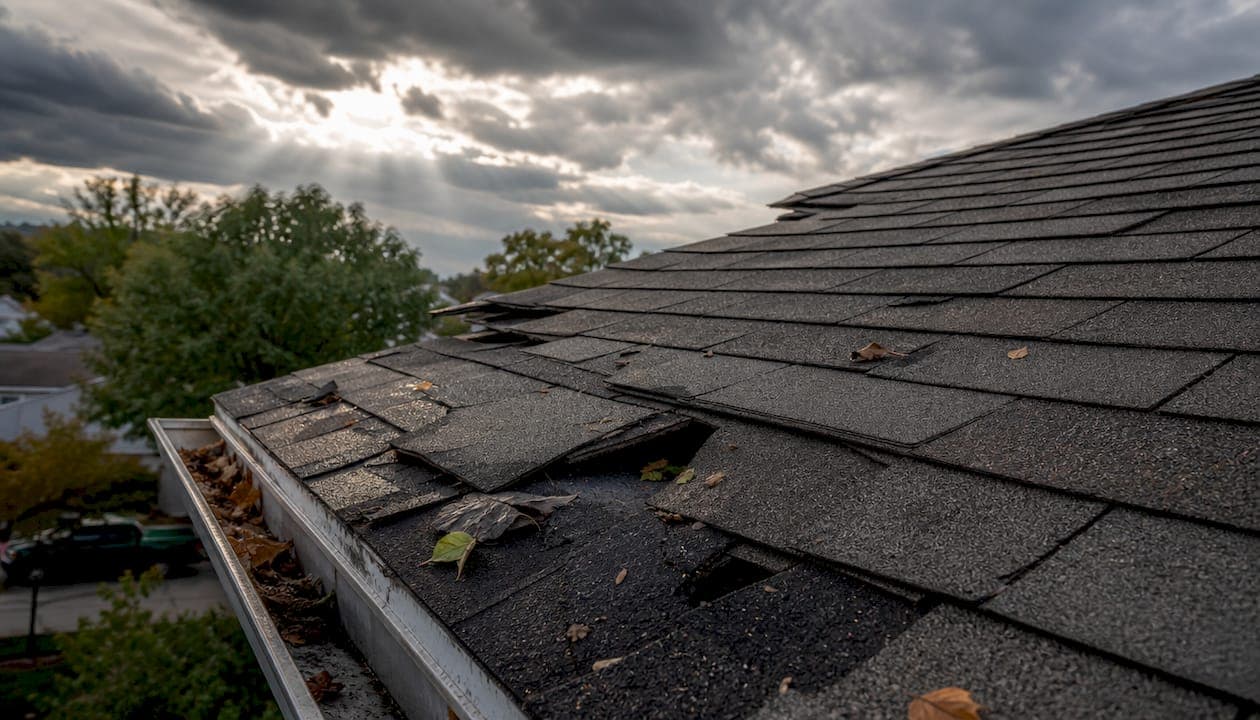
Shingles blow off roofs because wind creates powerful uplift forces that pull them upward, not just push them sideways. This distinction matters. The same aerodynamic principle that lifts an airplane wing acts on your roof during a storm, generating low pressure above the shingles and literally sucking them off the deck. Roof edges and corners experience 2 to 3 times higher uplift pressure than the center field, making perimeter detailing the single most critical factor in wind resistance. Understanding why shingles blow off in wind puts you in a position to prevent it.
Why do shingles blow off in wind?
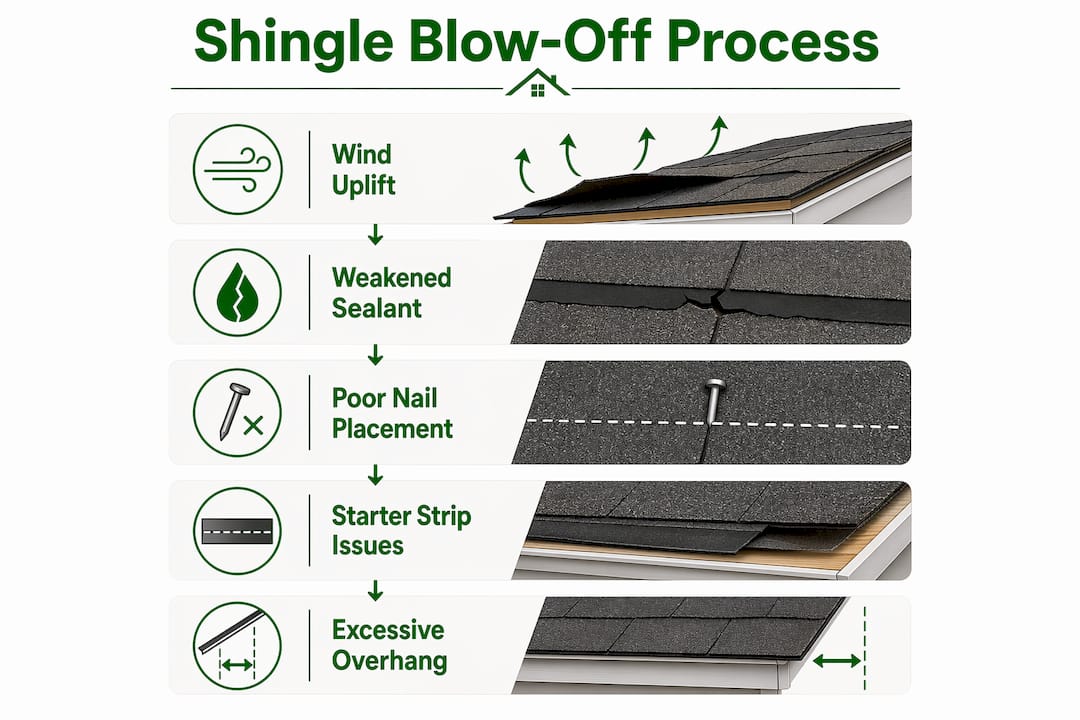
Wind does not simply knock shingles sideways. It acts like a wing, creating low pressure above the roof surface and high pressure below, generating an upward lift force. Wind creates lift similar to airplane wings, and once that force exceeds the holding strength of the sealant strip and nails, a shingle tab peels free.
Roof shape plays a significant role in how severe that lift becomes. Gable roofs are more vulnerable than hip roofs because gable ends act like sails, amplifying uplift at corners and rakes. Complex roof shapes can also create localized suction zones that concentrate pressure in unexpected spots.
Wind uplift is not a single event. It is a cumulative stress on sealant bonds and fasteners that weakens them over time. By the time a shingle actually flies off, the failure has usually been building for months or even years.
The perimeter zones of any roof, including eaves, rakes, and corners, bear the brunt of this pressure. Those zones experience 200%–300% of center roof uplift pressure, which is why shingles at the edges almost always go first. Once one tab lifts, wind gets underneath and the damage spreads fast.
- Eaves and rakes face the highest sustained uplift during storms.
- Corners experience turbulence from multiple wind directions simultaneously.
- Center field shingles are the last to fail because uplift pressure there is lowest.
- Steep slopes increase the angle of attack, worsening edge uplift on gable ends.
Common installation errors that cause shingles to come off
Shingles blowing off in moderate winds of 40–60 mph almost always point to an installation problem, not a material failure. Shingles lost in 40–60 mph winds usually indicate installation failure, while only winds above 90 mph are likely to exceed a properly installed shingle's rated capacity.
Nailing errors
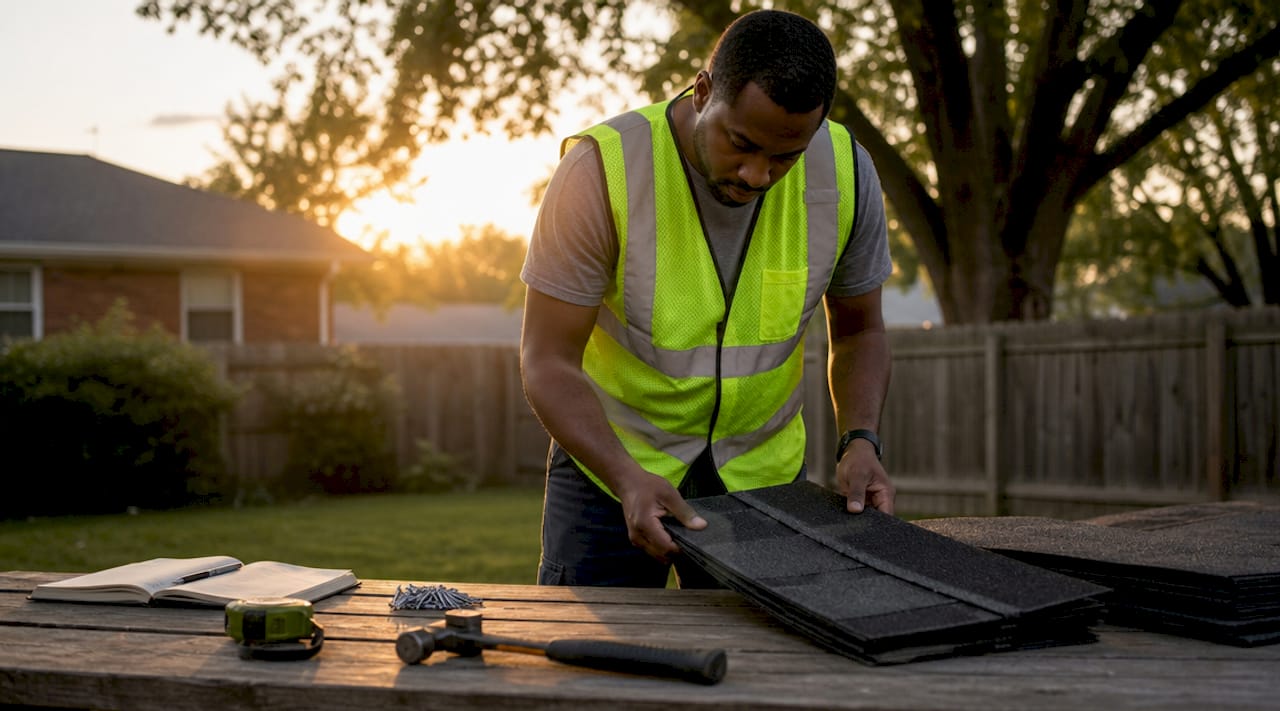
Nail placement is the most common and most damaging installation mistake. Nails driven outside the manufacturer's designated nail zone reduce wind resistance dramatically. Nails outside the nail line reduce wind resistance by up to 50% and often void the manufacturer's warranty entirely. Pneumatic nailers set at the wrong pressure compound the problem. Over-driven nails cut through the shingle mat, and under-driven nails leave the head proud, creating a pivot point that lets the shingle rock and eventually peel.
Sealant strip failures
Every asphalt shingle has a thermoplastic sealant strip that bonds to the shingle below it when warmed by the sun. That bond is what holds tabs flat against wind uplift. Cold-weather installation without sealant activation and dust contamination both prevent this bond from forming. A shingle installed in january on a cold roof may sit through an entire winter with zero adhesive bond, held only by its four nails.
Missing or misapplied starter strips
Starter strips are the first row of material along the eave. They provide the sealant surface that the first course of shingles bonds to. Absent or misapplied starter strips are a leading cause of first-row blow-off, because without them, the bottom edge of the first course has nothing to seal against.
Excessive shingle overhang
Shingles that extend too far past the drip edge act like a sail. Minimizing overhang to 1/4 inch past the drip edge dramatically reduces wind leverage at the eave. Every extra inch of overhang gives wind more surface to grab.
Pro Tip: If you are replacing shingles after a storm, check the nail placement on the surviving shingles nearby. Nails driven too high or too low are a sign the whole roof may be under-fastened and vulnerable to the next storm.
How shingle wind ratings and material age affect blow-off risk
Modern asphalt shingles carry wind uplift ratings that range from 60 mph for Class A up to 150 mph for Class H. Those ratings only hold under one condition: sealant activation requires several days above 40°F after installation. A Class H shingle installed in cold weather and never properly bonded performs no better than an unrated shingle in a storm.
Material age matters just as much as the initial rating. The thermoplastic adhesive that forms the sealant bond degrades over time. Freeze-thaw cycles are especially damaging. Each winter, water works into microscopic gaps in the sealant, freezes, expands, and widens those gaps. Adhesive fatigue from freeze-thaw cycles means a 20-year-old roof with a Class F wind rating may actually perform closer to a Class A in a severe storm.
| Wind Rating Class | Rated Wind Speed | Key Requirement |
|---|---|---|
| Class A | 60 mph | Standard installation, warm-weather sealant activation |
| Class D | 90 mph | Proper nail zone placement, activated sealant |
| Class F | 110 mph | Six nails per shingle, perimeter reinforcement |
| Class G | 120 mph | Enhanced fastening pattern, starter strips required |
| Class H | 150 mph | Full perimeter detailing, manufacturer-specified nailing |
Higher-rated shingles require more nails per shingle and tighter fastening patterns to actually achieve their rated performance. A Class H shingle installed with four nails instead of six will not survive a 150 mph wind event. The rating is a ceiling, not a guarantee.
Pro Tip: Ask your roofer for the shingle manufacturer's installation guide before work begins. If they cannot produce it or seem unfamiliar with the nailing pattern, that is a red flag worth acting on.
Why shingle loss starts at the edges and spreads inward
Shingle loss rarely begins in the middle of a roof. It starts at the perimeter and works inward through a process roofers call the zipper effect. Once a single shingle tab lifts, wind unzips adjacent shingles in a cascading sequence, because each lifted tab exposes the edge of the next one to direct uplift pressure.
The sequence of failure follows a predictable pattern:
- Wind pressure concentrates at the eave or rake edge, where uplift is highest.
- A tab with a weak or unactivated sealant bond lifts slightly.
- Wind gets underneath that tab and begins prying at the next shingle in line.
- The sealant bond on the adjacent shingle, already stressed, breaks free.
- Water infiltrates the exposed deck, accelerating deterioration of the underlayment and sheathing.
- Each subsequent storm finds a larger exposed area and causes progressively worse damage.
Proper starter strips and drip edge metal interrupt this sequence at step one by giving the first course a solid sealant surface and a rigid edge to bond against. Without them, the eave is the weakest point on the entire roof. Reinforcing the perimeter is not just about aesthetics or water management. It is the primary defense against cascading shingle loss.
Minor repairs after wind damage do not stop future shingle loss. Professional reinforcement of the perimeter is necessary to prevent the zipper effect from repeating in the next storm.
Practical steps to keep shingles from blowing off
Preventing shingle blow-off is mostly about catching small problems before they become large ones. A roof that looks fine from the ground can have lifted tabs, cracked sealant, and misplaced nails that will fail in the next significant wind event.
- Inspect after every storm. Walk the perimeter and look for slightly lifted tabs and inconsistent shadow lines, which are the earliest visible signs of sealant failure.
- Verify nail placement. Any replacement shingles must be nailed within the manufacturer's designated nail zone. Deviations cause premature failure and void warranties.
- Limit overhang. Keep shingle and starter strip overhang to 1/4 inch or less past the drip edge to minimize wind leverage at the eave.
- Choose the right wind rating. Match your shingle class to local wind conditions. Chattanooga and surrounding areas see regular storm activity that warrants at least a Class D or Class F rated shingle.
- Install proper starter strips. Never skip or substitute starter strips. They are the anchor point for the entire first course.
- Schedule a professional inspection after storms. A storm damage roof assessment catches hidden damage before it triggers the zipper effect.
Pro Tip: Shingles rarely blow off because of one strong storm alone. They blow off because of a cumulative effect of prior minor damage and installation faults that went unaddressed. Regular inspections break that cycle.
Key Takeaways
Shingles blow off roofs primarily because wind uplift overcomes weakened sealant bonds and improperly placed fasteners, with roof edges and corners failing first and damage cascading inward.
| Point | Details |
|---|---|
| Wind acts as uplift, not push | Low pressure above the roof pulls shingles upward, making perimeter detailing the top priority. |
| Edges fail first | Eaves, rakes, and corners experience 2–3 times more uplift pressure than the center field. |
| Installation errors are the main cause | Nails outside the nail zone and unactivated sealant strips cause most moderate-wind blow-offs. |
| Wind ratings require proper installation | A Class H shingle installed incorrectly performs no better than a basic Class A shingle. |
| Cascading damage is preventable | Proper starter strips, drip edge metal, and prompt inspections stop the zipper effect before it starts. |
What I have learned from watching roofs fail
After years of seeing roofs come apart after storms, the pattern is almost always the same. The shingles that blow off are rarely the newest or the most expensive ones on the street. They are the ones where someone cut a corner during installation, or where the homeowner skipped the post-storm inspection one too many times.
The detail that surprises most homeowners is how little wind it actually takes to start a failure. A roof with unactivated sealant strips and nails driven a half-inch too high can lose tabs in a 50 mph gust. That is a strong thunderstorm, not a hurricane. The physics are unforgiving. Wind does not care about the shingle's rated speed if the bond was never formed in the first place.
What I have found consistently is that the roofs that hold up best are not always the ones with the highest-rated shingles. They are the ones where the perimeter was treated seriously. Solid starter strips, drip edge metal installed correctly, and nails placed exactly where the manufacturer specified. Those three details account for the majority of wind failures I have seen, and they are all within a homeowner's ability to verify before signing off on any roofing job.
The other lesson is to act fast after any storm. A temporary roof repair buys time, but it does not fix the underlying vulnerability. The zipper effect is patient. It will wait for the next storm.
— Steve
Roof repair and shingle replacement in Chattanooga
When wind takes shingles off your roof, the clock starts immediately. Every hour of exposed deck is an hour of potential water damage to your sheathing, insulation, and interior.
Chattanoogaroofrepairs provides storm and hail damage repair across Chattanooga and surrounding areas, including same-day emergency tarping to stop water intrusion before permanent repairs begin. The team handles full shingle replacement using GAF and Owens Corning materials, installed to manufacturer specifications with correct nail placement and sealant activation. Every job includes a 21-point inspection to identify perimeter vulnerabilities before they trigger cascading damage. Transparent pricing, no-pressure estimates, and fully insured crews mean you get honest answers and quality workmanship from a team that knows Chattanooga roofs.
FAQ
Why do shingles blow off in moderate winds?
Shingles blowing off in 40–60 mph winds almost always indicate an installation failure, such as nails outside the nail zone or sealant strips that never bonded. Properly installed shingles rated for those speeds should not fail.
How does wind actually lift shingles off a roof?
Wind creates low pressure above the roof surface and high pressure below, generating an upward lift force similar to an airplane wing. This force concentrates at edges and corners, where it can be 2–3 times stronger than at the center of the roof.
What is the zipper effect on a roof?
The zipper effect occurs when one lifted shingle tab exposes the edge of the next shingle to direct wind uplift, causing a chain reaction of shingle loss that spreads from the perimeter inward across the roof.
Do higher wind-rated shingles guarantee better protection?
Not automatically. A Class H shingle rated for 150 mph must be installed with the correct number of nails in the right location and with the sealant strip properly activated. Without those conditions, the rating does not apply.
How can I tell if my shingles are at risk before a storm?
Look for slightly lifted tabs, inconsistent shadow lines across the roof surface, or shingles with visible gaps at the edges. These are early signs of sealant failure or improper nailing that a professional inspection can confirm and address.