
The fastest way to minimize business downtime during roof repair is a coordinated plan that combines phased work, off-peak scheduling, and an operational impact plan led by a single point of contact. Before your contractor sets foot on the roof, three decisions lock in most of your protection: how the work is phased, when crews show up, and who communicates with your team daily.
Here are the highest-impact tactics to act on immediately:
- Request a phased schedule with watertight stopping points at the end of each zone so interior operations stay protected overnight.
- Require off-peak or weekend scheduling for noisy demolition and crane lifts to protect customer traffic and employee productivity.
- Ask for an operational impact plan as a contract deliverable — a written document covering parking, HVAC windows, access routes, and delivery coordination.
- Consider liquid-applied silicone elastomeric membranes as a zero-downtime restoration option. Restoration using liquid-applied silicone membranes can often be completed without a tear-off, keeping HVAC and interior operations intact throughout.
- Verify manufacturer-backed warranties (GAF and Owens Corning are the benchmarks) and confirm the contractor is licensed and insured before signing.
Detailed logistics planning can reduce overall project duration—and therefore business disruption—by roughly 15–20%. OSHA is the governing safety standard for all on-site work. Chattanoogaroofrepairs brings all of these elements together for commercial clients in Chattanooga and the surrounding area, including same-day tarping for active leaks.
Table of Contents
- Why roofing downtime costs more than most owners expect
- How to build a phasing and scheduling plan that protects operations
- How to select the right commercial roofing contractor
- On-site tactics that cut noise, dust, and access disruption
- Who to notify, when, and what to say
- Weather planning and temporary protection to avoid schedule blowouts
- Post-project inspection, cleanup, and getting back to normal fast
- How Chattanoogaroofrepairs minimizes business disruption
- Key Takeaways
- What facility managers running 24/7 operations actually do
- Chattanoogaroofrepairs: fast, professional commercial roofing in Chattanooga
- Selected sources and further reading
Why roofing downtime costs more than most owners expect
A leaking or failing commercial roof rarely causes just one problem. Lost production, customer traffic disruption, tenant relocation costs, and reputational damage pile up fast, and the financial exposure is often larger than the repair bill itself.
A simple cost formula helps decision-makers quantify the stakes before the project starts:
Estimated downtime cost = (lost revenue per hour × expected hours lost) + recovery costs + temporary protection measures
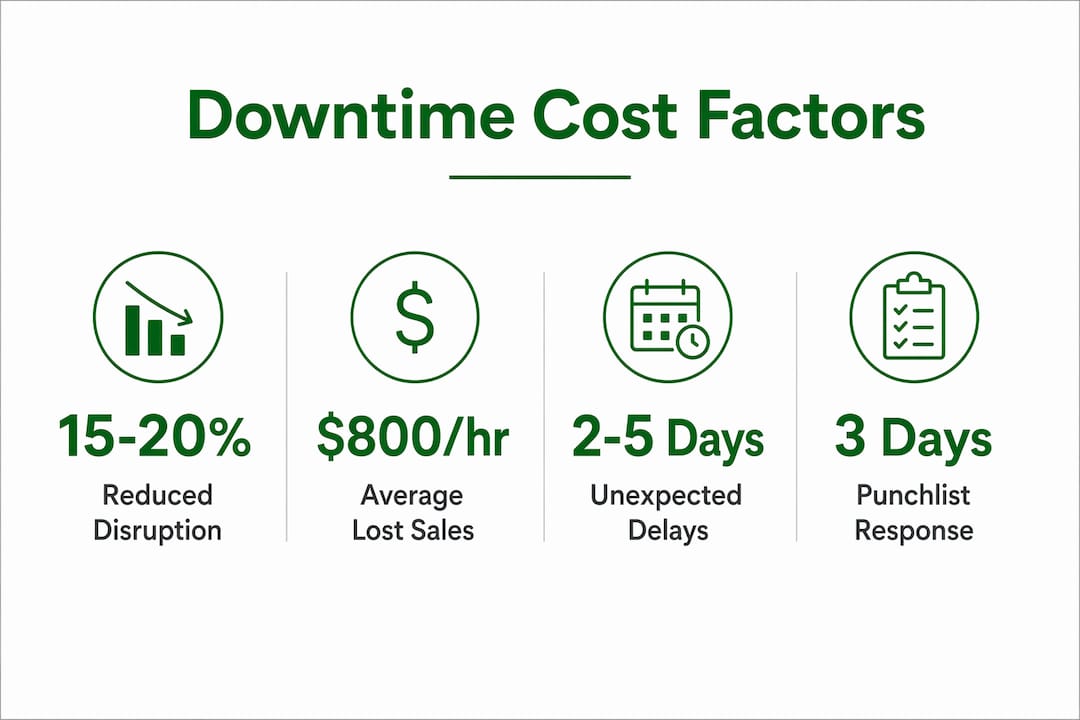
For a small retail site averaging $800 per hour in sales, two days of reduced traffic during a noisy tear-off could represent $12,800 in lost revenue before a single repair invoice arrives. A light manufacturing floor with contractual delivery windows faces a different risk: penalty clauses triggered by missed shipments. The downstream costs of delayed repair compound quickly once water reaches insulation, inventory, or electrical systems.
| Downtime Driver | Typical Impact | Mitigation |
|---|---|---|
| Unexpected hidden damage | Adds 2–5 days to schedule | Pre-bid drone inspection |
| Poor material staging | Daily access conflicts | Pre-staged laydown plan |
| Weather delays | 1–3 days per weather event | Seasonal buffer days in contract |
| No phasing plan | Full building disruption | Phased zone schedule |
| Communication gaps | Tenant/customer complaints | Single point of contact + daily updates |
Pro Tip: Before soliciting bids, pull together pre-project documentation: photos, previous repair receipts, and any inspection reports. Thorough pre-project documentation speeds contractor scoping, supports insurance claims, and prevents mid-project scope creep that blows up your timeline.
How to build a phasing and scheduling plan that protects operations
Phasing works best on large roofs where different building zones serve different operational functions. A warehouse with a separate office wing, for example, can keep the office fully operational while the warehouse section is torn off and replaced. The key lies in sizing each phase correctly.

For small roofs, phasing can actually increase total disruption. Each mobilization adds setup and teardown days, so a 3,000-square-foot roof that could be completed in two concentrated days might stretch to five days across three phases. Evaluate by comparing days lost per mobilization against the cost of a short, concentrated shutdown.
Sample phased schedule for a mid-size commercial roof:
- Pre-project: drone inspection, scope lock, permit pull, material delivery to staging area.
- Phase 1 (Zone A): tear-off, inspection of deck, installation, and watertight close-out by end of day.
- Phase 2 (Zone B): begin next morning; Zone A is fully watertight and operational below.
- Phase 3 (Zone C): final zone, including all penetrations, flashing, and edge metal.
- Punch walk: full inspection, moisture scan if applicable, HVAC reconnection, debris sweep.
Phased replacement and temporary protection let businesses maintain substantial operations while work progresses, but phases must be sized correctly to avoid excessive mobilization days. Build weather buffers into the schedule: two to three buffer days per week of work in spring and fall, one day per week in summer, and four or more days per week in winter for regions with freeze-thaw cycles.
Pro Tip: When requesting bids, ask each contractor to include a pre-staged materials plan showing where the dumpster, crane, and material pallets will sit. Contractors who cannot answer this question in the bid stage will create daily access conflicts once work begins.
| Phase | Zone Size | Crew Output/Day | Watertight by EOD? | Mobilization Days |
|---|---|---|---|---|
| Phase 1 | — | 6,000–— | Yes | 1 |
| Phase 2 | — | 6,000–— | Yes | continuous |
| Phase 3 | — | — | Yes | continuous |
| Weather buffer | — | — | — | 2–3 days built in |
A complete drone inspection and accurate pre-bid scope substantially reduce the unknowns that cause schedule blowouts. Require aerial documentation as part of the contractor's bid package.
How to select the right commercial roofing contractor
Not every contractor who does residential work is equipped for a continuous-operation commercial project. The hiring checklist is short but non-negotiable.
Contractor qualification checklist:
- Commercial roofing experience on occupied buildings
- Licensed and insured in your state, with certificates of insurance naming your business
- Manufacturer certifications (GAF Master Elite or Owens Corning Preferred Contractor)
- References for similar jobs where the building stayed open during work
- Demonstrated off-hours and weekend scheduling capability
- Written daily reporting cadence and a named single point of contact
During qualification interviews, ask specifically: "What does your operational impact plan look like?" and "How do you handle a weather delay that threatens a watertight close-out?" Contractors who answer vaguely on logistics are a red flag regardless of price.
Pro Tip: Require the operational impact plan as a contract deliverable before work begins, not a verbal promise. This shifts vague assurances into enforceable obligations and gives you a paper trail if the contractor deviates.
| Evaluation Criterion | Green Flag | Red Flag |
|---|---|---|
| Timeline detail | Line-item schedule with milestones | "We'll get it done in about a week" |
| Contingency plan | Written tarping and re-sequencing plan | No mention of weather or surprises |
| Communication | Named single point of contact | "Call the office if you need anything" |
| Warranty | Manufacturer-backed, written | Verbal only or "standard workmanship" |
| Quote format | Line-itemed with contingency allowance | Lump sum with no breakdown |
Thorough pre-project documentation also benefits the contractor selection process: when you hand bidders complete photos and prior inspection reports, you get more accurate quotes and fewer change orders mid-project. Require contract clauses covering phased milestones, liquidated delay allowances, daily progress reporting, and insurer notification obligations.
On-site tactics that cut noise, dust, and access disruption
The physical site setup determines how much your staff and customers actually feel the project. A well-planned site map keeps construction activity invisible to most of the building.
Site setup essentials:
- Designate a materials laydown zone away from customer entrances and loading docks.
- Mark crane lift zones and schedule all lifts before 7:00 AM or after business hours.
- Install barricades and clear signage at every entry point to the work zone.
- Set explicit noise windows in the contract: loud demolition only during agreed hours.
- Use covered debris chutes rather than open drops to contain dust and falling material.
- Conduct daily magnetic sweeps of the parking lot and all pedestrian areas.
For dust-sensitive environments such as food production, pharmaceutical operations, or medical offices, interior suspended shrink-wrap ceilings provide airtight isolation. These systems use 9-mil to 12-mil heat-shrinkable polyethylene, heat-welded at the seams, installed below the roof deck above lights and machinery. Production continues underneath while the tear-off happens above. Systems must meet NFPA 701 standards for flame propagation in occupied buildings.
Scheduling noisy tasks during agreed noise windows and coordinating crane lifts outside peak hours measurably reduces customer complaints and employee productivity loss. Coordinate HVAC shutdowns in advance so the building's air handling is not compromised during tear-off of sections near rooftop units.
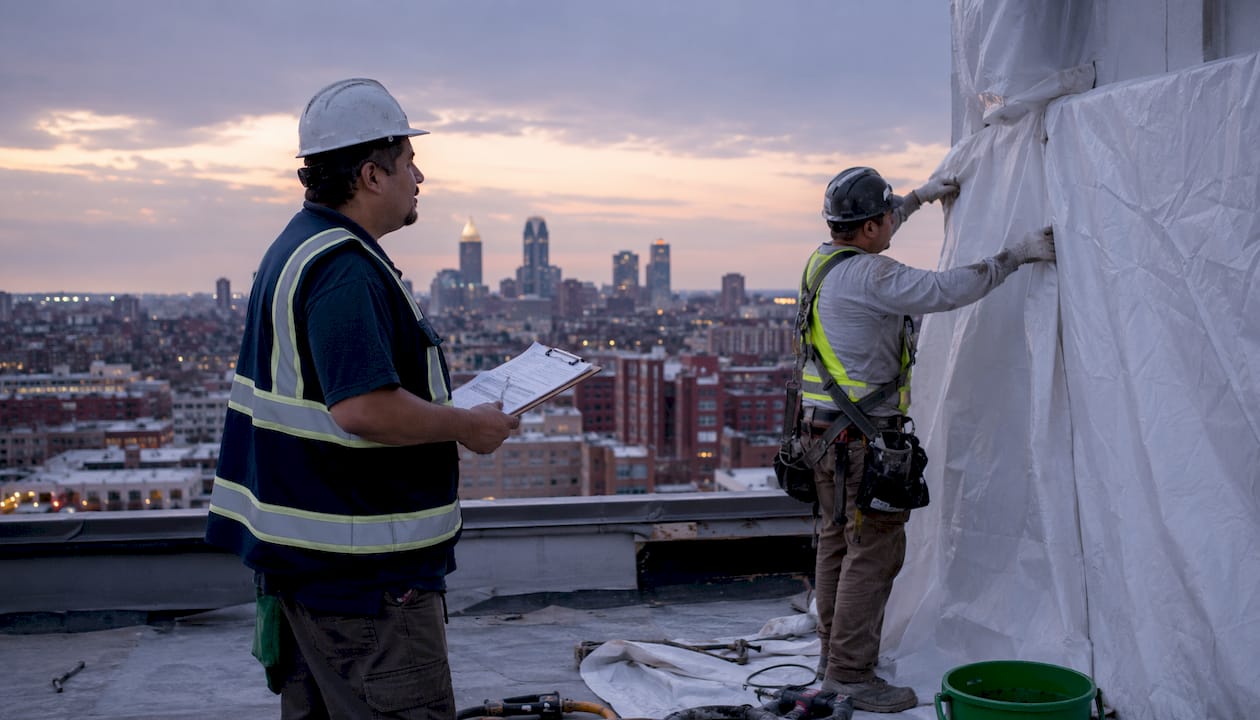
Pro Tip: Ask your contractor for a site-specific OSHA safety plan before work begins. It should cover fall protection, PPE requirements, barricade placement, and daily safety briefings. A contractor who cannot produce this document is not ready to work on an occupied building.
Who to notify, when, and what to say
Poor communication creates more perceived disruption than most on-roof activities. Surprises about parking restrictions or unexpected loud work at 6:00 AM generate complaints that damage tenant relationships and customer loyalty far beyond what the actual noise warrants.
Notification list:
- Employees: pre-project briefing covering parking changes, noise windows, and access route modifications.
- Tenants: written notice at least five business days before work begins, with a daily update channel.
- Suppliers and delivery services: revised dock access windows and any temporary restrictions.
- Customers: signage at entrances, updated website notice if applicable, and a brief explanation of the timeline.
- Emergency services and on-site security: site map with exclusion zones and contractor contact information.
The daily end-of-day update should cover three items: work completed that day, work planned for tomorrow, and any schedule changes or access impacts. Keep it to a half-page or a brief email. Tracking and managing tenant repair requests through a single channel prevents duplicate calls and missed issues.
Lock in these operational coordination items before day one: HVAC downtime windows, agreed access routes for crews and deliveries, parking math (how many spaces the contractor needs versus how many remain for customers), and security protocols for loading docks during off-hours work.
Weather planning and temporary protection to avoid schedule blowouts
Weather is the most common cause of commercial roof project overruns, and it is also the most preventable with the right contract language and temporary protection systems.
Temporary protection options by situation:
- Same-day emergency tarping: the right first response for an active leak or storm damage. Stops water immediately and buys time for a proper repair scope. Chattanoogaroofrepairs provides same-day tarping for active leaks.
- Fluid-applied membrane patches: appropriate for isolated failures on flat roofs where a full tear-off is not yet warranted. Applied cold, no open flame, minimal equipment footprint.
- Temporary cover boards: used during phased replacement to protect exposed deck sections overnight or over a weekend when work cannot be completed in a single day.
Facility managers should address ponding water within 48 hours to prevent membrane degradation and deck rot that can trigger expensive emergency shutdowns. Build this into your go/no-go decision framework: if standing water is present at the end of a workday, the contractor must address it before leaving the site.
Pro Tip: When reviewing bids, ask each contractor: "How many weather buffer days have you built into this schedule, and what is your assumption for this season?" A contractor who has not thought about this will give you a best-case timeline that falls apart at the first rain event.
For contingency planning, require a written re-sequencing plan in the contract that addresses material delivery delays and permit hold-ups. Temporary roof repair options for storm-damaged properties follow the same logic: protect first, scope second, repair third.
Post-project inspection, cleanup, and getting back to normal fast
The project is not finished when the last shingle goes down. A structured close-out process protects your warranty, confirms the work is complete, and restores full operations quickly.
Post-project inspection checklist:
| Item | Action Required | Responsible Party |
|---|---|---|
| Debris sweep (roof) | Remove all material, fasteners, packaging | Contractor |
| Magnetic sweep (parking lot) | Collect all metal fasteners and debris | Contractor |
| Roof penetration inspection | Verify all seals, boots, and flashing are watertight | Contractor + owner rep |
| HVAC and rooftop equipment | Confirm reconnection and test operation | Facility manager |
| Interior barriers removal | Remove shrink-wrap, signage, and temporary partitions | Contractor |
| HVAC intake cleaning | Clear any dust or debris from air handling units | Facility manager |
| Punchlist documentation | Photo-document any incomplete or deficient items | Owner rep |
| Warranty handover | Receive manufacturer warranty certificate and workmanship warranty | Contractor |
Require the contractor to respond to punchlist items within three business days of the final walk. Write this response window into the contract before work begins. Store all warranty documents, inspection photos, and moisture scan results in a dedicated project file — your insurer and any future buyer will ask for them.
Roof repair documentation best practices cover what to keep, how to organize it, and how it supports insurance claims and future maintenance planning. A complete post-project file also makes the next inspection faster and the next contractor's scoping more accurate.
How Chattanoogaroofrepairs minimizes business disruption
Chattanoogaroofrepairs follows the same best practices this guide describes, applied specifically to commercial clients in Chattanooga and the surrounding region. The process starts with a 21-point inspection that documents existing conditions before any work is scoped, giving you a clear baseline and reducing the risk of mid-project surprises.
What Chattanoogaroofrepairs brings to a commercial project:
- Same-day tarping for active leaks, so water stops moving through your building while the repair scope is being finalized.
- Phased planning with a documented operational impact plan covering parking, HVAC coordination, access routes, and delivery windows.
- A single named point of contact who provides daily progress updates throughout the project.
- Licensed and insured credentials, with manufacturer partnerships through GAF and Owens Corning for manufacturer-backed warranties.
- Detailed line-item schedules with contingency allowances, not lump-sum guesses.
- Post-project inspection reports with photos and warranty handover documentation.
For sensitive commercial environments, the team coordinates interior containment and HVAC scheduling so production or customer-facing operations continue with minimal interruption. Commercial roof repairs done right keep your building functional from day one of the project through final close-out.
Pro Tip: When you contact Chattanoogaroofrepairs, specifically request an operational impact plan as part of your free inspection and estimate. This document becomes the foundation of your project's communication and scheduling plan.
Key Takeaways
Phased work, off-peak scheduling, and a single point of contact are the three decisions that most reduce business disruption during commercial roof repair, and all three belong in the contract before work begins.
| Point | Details |
|---|---|
| Phase and schedule strategically | Phased zones with watertight daily close-outs protect operations; off-peak scheduling cuts noise impact. |
| Plan logistics in detail | Detailed logistics planning can reduce overall project duration—and therefore business disruption—by roughly 15–20%. |
| Require an operational impact plan | A written plan covering parking, HVAC, access, and deliveries turns verbal assurances into enforceable obligations. |
| Use liquid-applied membranes when possible | Silicone elastomeric restoration avoids tear-off entirely, keeping HVAC and interior operations intact throughout. |
| Chattanoogaroofrepairs | Provides same-day tarping, 21-point inspections, phased planning, and manufacturer-backed warranties for commercial clients. |
Immediate actions if your roof is failing right now:
- Call for same-day tarping to stop active water intrusion.
- Document current damage with photos and note any prior repair history.
- Request a free inspection and ask specifically for an operational impact plan with the estimate.
What facility managers running 24/7 operations actually do
The conventional wisdom on commercial roof repair tends to focus on the roof itself. Facility managers who run continuous operations think about it differently: the roof is a scheduling problem first and a construction problem second.
The most effective operators I have seen treat the operational impact plan as the most important document in the project, not the spec sheet. They schedule work over planned maintenance windows when production is already down, which eliminates the disruption calculation entirely. When that is not possible, they use interior suspended containment for dust-sensitive lines rather than halting production, accepting the installation cost as far cheaper than a shutdown.
There is also a genuine trade-off between restoration and replacement that most guides gloss over. Liquid-applied silicone membranes cost less per square foot than a full tear-off and replacement, and they eliminate the debris, noise, and equipment footprint that create most of the operational disruption. For a roof that is 60–70% through its service life with localized failures, restoration is often the right call on both cost and uptime grounds.
The metric that matters most to experienced facility managers is not project cost per square foot. It is uptime percentage during the project. A contractor who costs 10% more but keeps 95% of the building operational is a better value than a lower bid that forces a two-day shutdown. Communication is the variable that most affects that number. Surprises about parking, noise, or access create more friction than the actual construction work.
Chattanoogaroofrepairs: fast, professional commercial roofing in Chattanooga
When your commercial roof needs attention and your business cannot afford to stop, Chattanoogaroofrepairs delivers the response speed and planning depth that keeps operations running. Same-day tarping stops active leaks immediately. The 21-point inspection gives you a documented baseline before any work is scoped. Phased scheduling, a single point of contact, and daily progress updates keep your team informed and your tenants calm throughout the project.
Relevant services for commercial clients include roof leak repair, emergency tarping, metal roofing installation and repair, and the full range of commercial roofing services backed by GAF and Owens Corning manufacturer warranties. Every project comes with transparent, line-itemed pricing and no-pressure estimates.
Contact Chattanoogaroofrepairs today to schedule your free inspection and request an operational impact plan. Know exactly how your project will run before the first crew arrives.
Selected sources and further reading
The following sources informed this guide. Each one is worth reviewing if you want to go deeper on a specific aspect of commercial roof project management.
- How to Minimize Business Downtime During Roof Replacement — covers logistics planning, communication cadence, and the 15–20% schedule reduction finding cited in this guide.
- How to Restore Your Commercial Roof with Zero Downtime — explains liquid-applied silicone membrane restoration as a no-tear-off alternative that keeps operations intact.
- How to Repair a Commercial Roof Without Shutting Down Operations — practical guidance on pre-project documentation, insurance coordination, and scope management.
- How to Minimise Downtime During Commercial Roof Repairs — phasing strategy and the trade-off between mobilization days and operational continuity.
- Minimizing Business Disruption During Commercial Roof Replacement — the case for drone inspection and pre-bid scope accuracy to prevent schedule blowouts.
- When Is a Puddle Not a Puddle? — the 48-hour ponding water response standard and its implications for membrane life and emergency shutdowns.
- Minimizing Manufacturing Downtime: Interior Shrink Wrap Solutions — detailed specifications for suspended shrink-wrap containment systems, NFPA 701 compliance, and production continuity during active tear-off.